Battery Pack Design for E-Bikes, E-Scooters, and Electric Motorcycles


SHARE
SHARE

Battery Pack Design for E-Bikes, E-Scooters, and Electric Motorcycles
E-bikes, e-scooters, and electric motorcycles may use similar lithium-ion cells, but their battery packs face different design challenges. A battery that fits an e-bike frame may not deliver enough current for an electric motorcycle, while a scooter battery must withstand vibration and road spray in a compact compartment.
For original equipment manufacturers (OEMs), these differences affect battery configuration, enclosure design, and testing requirements long before production begins.
Why Does Battery Pack Design Differ Across Electric Two-Wheelers?
Battery pack design differs because each vehicle places different demands on space, power delivery, vibration resistance, and environmental protection. The battery must fit the vehicle's structure while supporting its intended operating conditions.
Design Factor | E-Bike | E-Scooter | Electric Motorcycle |
Installation space | Frame tubes, downtube, or rear rack | Deck or stem compartment | Central frame or dedicated battery compartment |
Power demands | Pedal assistance and hill climbing | Acceleration and climbing | Higher sustained and peak power |
Vibration | Road shocks transmitted through the frame | Frequent deck vibration and road impacts | Vibration and dynamic chassis loads |
Environmental exposure | Rain, mud, and temperature changes | Road spray, dust, and debris | Weather exposure and significant thermal loads |
Design priority | Compact fit and weight distribution | Space efficiency and mechanical protection | Power delivery and heat management |
These differences help explain why a battery that works for one vehicle may not suit another. Before exploring the design details, OEMs should first consider whether a standard battery can meet their project requirements or whether customization is needed.
When Should OEMs Choose a Custom Battery Pack Over a Standard One?
A custom battery pack is worth considering when an off-the-shelf battery cannot meet your vehicle's space, power, or integration requirements. However, standard packs remain a practical choice when their specifications already match the application.
For example, an e-bike manufacturer may find a battery with the right voltage and capacity, only to discover that it does not fit the frame or support the required controller communication. In this case, custom development may avoid redesigning the vehicle around an unsuitable battery.
Three situations commonly justify a custom solution:
l Space and mounting conflicts: Standard packs cannot fit the available frame or scooter deck space, or require changes to mounting and locking systems.
l Specific electrical requirements: The vehicle needs particular discharge currents, battery management system (BMS) communication, or thermal management that standard packs cannot provide.
l Production-specific requirements: Available standard packs cannot consistently meet the required dimensions, connector configurations, or BMS settings across production batches.
For early prototypes or low-volume projects, a compatible standard pack may be more economical. However, when these constraints cannot be resolved with an existing battery, working with a custom battery pack manufacturer early can reduce integration problems and repeated design changes.
The following sections explain how these challenges affect battery design for e-bikes, e-scooters, and electric motorcycles.
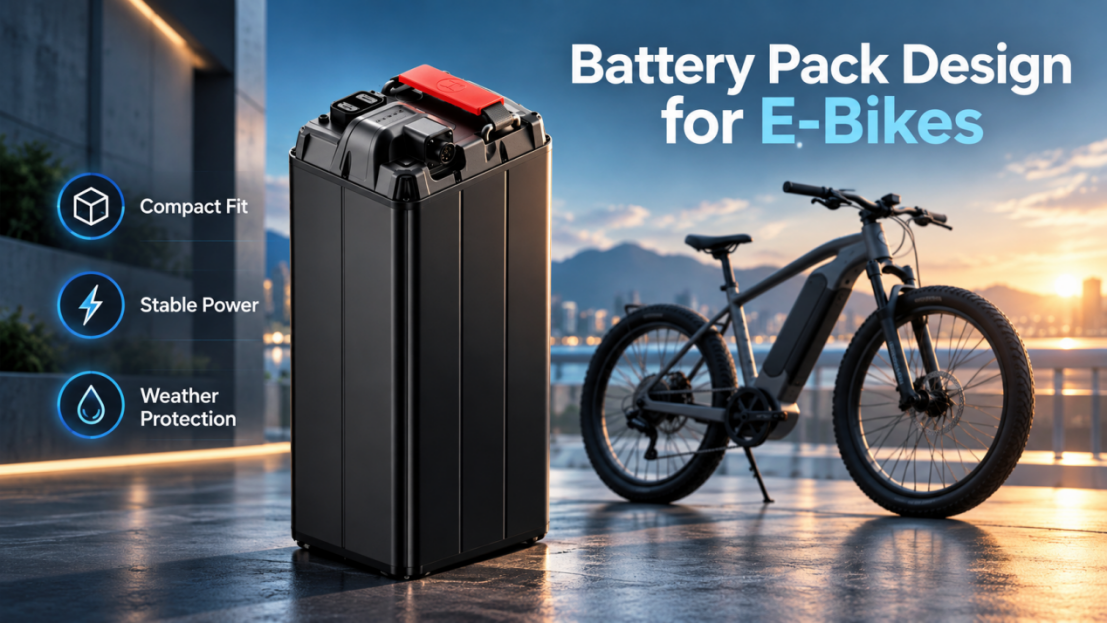
What Are the Main Battery Design Challenges for E-Bikes?
E-bike battery design centers on fitting sufficient energy into a limited frame space without adding unnecessary weight. Electrical performance must also match the motor controller and expected riding conditions.
How Does Frame Geometry Affect E-Bike Battery Design?
Frame geometry determines battery dimensions, mounting, and accessibility, whether the pack is installed in-tube, on the downtube, or on a rear rack.
For a custom ebike battery, four details deserve attention:
l Available space: The enclosure must fit the frame's usable dimensions and mounting tolerances.
l Battery retention: Locks and mounting points must keep the pack secure during riding.
l Electrical connections: Connector placement should support assembly, charging, and maintenance.
l Weight distribution: Pack placement should account for the bicycle's balance and handling.
For example, an in-tube battery may need a long, narrow enclosure that follows the frame's internal geometry. A rectangular pack with sufficient capacity is of little use if it cannot pass through the battery opening or clear the mounting hardware.
How Do Motor Power and Road Conditions Affect E-Bike Batteries?
Motor and controller specifications determine the required battery voltage and discharge capability. Road conditions then influence the protection needed for the enclosure, connectors, and internal components.
In a battery pack for electric bike project, capacity alone does not determine suitability. The cells and electrical connections must also support the current required during acceleration and climbing.
Repeated road vibration introduces another challenge. If mounting components or connectors loosen over time, electrical reliability may suffer. Therefore, engineers need to consider vibration resistance, secure cell retention, and environmental sealing alongside electrical performance.
What Makes E-Scooter Battery Pack Design Different?
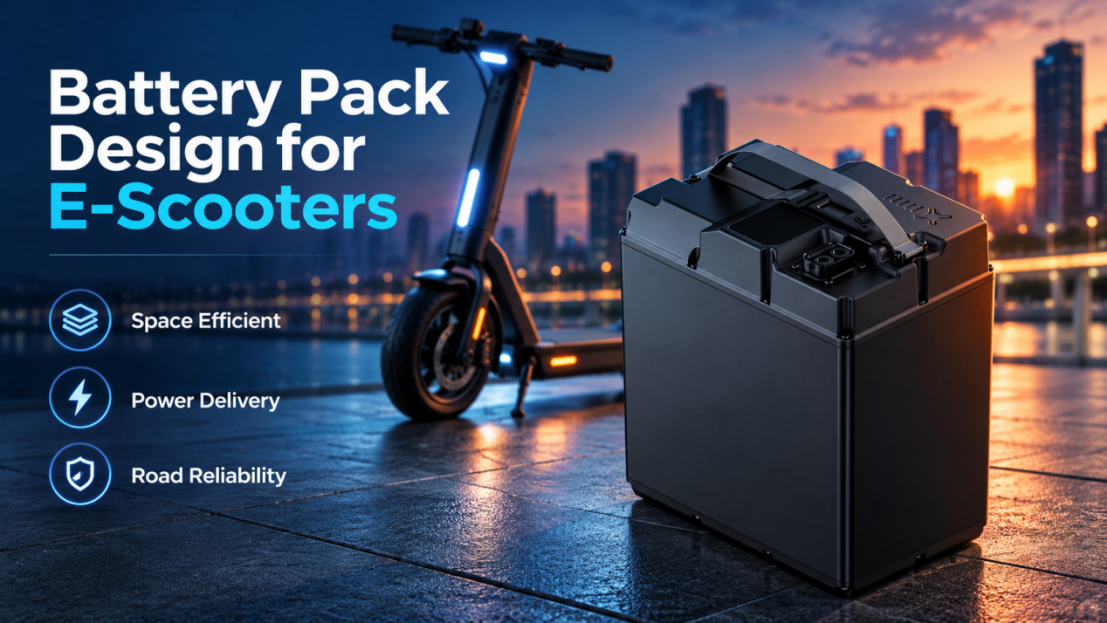
E-scooter battery design places greater emphasis on compact packaging and protection against road-related stresses. For many standing electric scooters, the battery sits inside the deck, where limited height and ground clearance restrict the available space.
Why Is Battery Packaging More Restrictive in E-Scooters?
A typical deck-mounted battery must share a shallow compartment with its BMS, wiring, insulation, and mounting components. This limits how cells can be arranged and how heat can escape.
When developing an e scooter battery pack, engineers should address three priorities:
l Cell configuration: Arrange cells within the available height and width while meeting energy and current requirements.
l Mechanical clearance: Reserve enough space for wiring, insulation, and secure attachment.
l Heat dissipation: Consider how heat moves out of the pack during charging and discharge.
Increasing capacity is not always as simple as adding cells. A larger pack may reduce ground clearance, increase weight, or leave insufficient space for protective components.
How Do Vibration and Water Exposure Influence E-Scooter Batteries?
Deck-mounted batteries face repeated shocks, road spray, and debris that can damage electrical connections and enclosure components.
Three design measures help address these risks:
l Mechanical support: Secure cells, electrical connections, and internal components against repeated vibration.
l Enclosure protection: Design seals and cable entries around the expected water and dust exposure.
l Reliability testing: Check the assembled pack under representative vibration, impact, and environmental conditions.
Water resistance also creates a design trade-off. A tightly sealed enclosure helps limit moisture entry, but it can make heat dissipation more difficult. Battery designers must evaluate both requirements rather than treating sealing and thermal management as separate problems.
How Do Electric Motorcycle Batteries Handle Higher Power Demands?
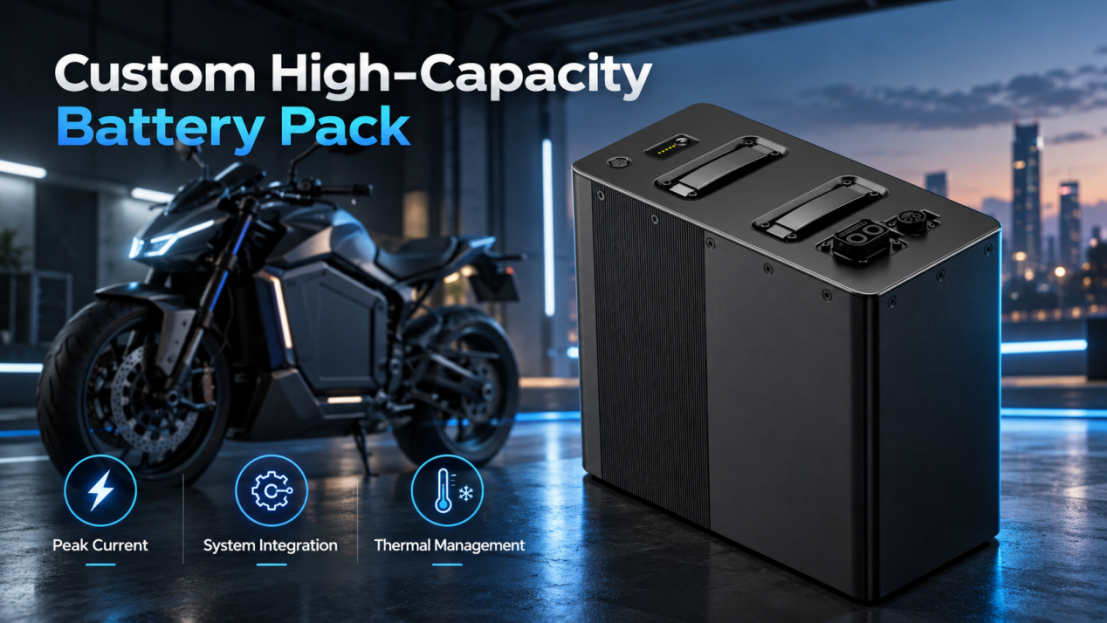
Electric motorcycle batteries generally require higher current capability and more substantial thermal and structural protection than lightweight electric two-wheeler batteries.
How Do Higher Discharge Currents Affect Battery Design?
Higher discharge currents influence cell selection, conductor sizing, electrical connections, and BMS protection settings. A battery designed for occasional power peaks may not be suitable for sustained high-load operation.
Engineers must consider:
l Continuous and peak current: Select cells and pack configurations that meet the vehicle's load profile.
l Electrical connections: Size busbars, cables, and connectors for the required current.
l BMS protection: Monitor operating conditions and respond to abnormal current, voltage, and temperature.
Higher current can also increase resistive heating. Therefore, electrical design and thermal management must be evaluated together.
Why Do Thermal Management and Structural Protection Matter?
Electric motorcycle batteries must manage heat while remaining secure under vehicle vibration and dynamic loads. Excessive temperature can affect battery performance and aging, while mechanical stress can damage mounting structures or electrical connections.
Depending on the application, engineers may use conductive thermal pathways, thermal interface materials, or other heat-management solutions.
Mechanical integration requires equal attention. The enclosure must accommodate pack weight, mounting loads, electrical insulation, and the available chassis space.
For example, placing a large battery inside a tightly enclosed central frame compartment may simplify weight distribution but reduce the space available for cooling and maintenance. These trade-offs should be addressed before the chassis design is finalized.
What Battery Requirements Should OEMs Define Before Development?
OEMs should establish the battery's electrical, mechanical, environmental, and production requirements before selecting a final pack architecture. A clear specification helps reduce design changes during prototype development.
A useful starting point is to answer five questions.
Design Question | What OEMs Need to Define |
What power must the battery deliver? | Voltage, capacity, continuous current, peak current |
Where will the battery be installed? | Available dimensions, mounting position, weight limit |
What operating conditions will it face? | Temperature, vibration, impact, water, and dust |
How will the battery integrate with the vehicle? | BMS functions, communication, charging interface |
What must be verified before production? | Safety requirements, target markets, reliability testing, production volume |
Certification requirements should also be addressed early. For example, UN 38.3 concerns lithium battery transport testing, while vehicle-specific battery safety requirements depend on the application and target market.
How Does SCUDPower Support Custom Battery Pack Development?
Founded in 2016, SCUDPower specializes in customized lithium-ion battery packs for OEM applications, including e-bikes, e-scooters, and electric motorcycles. Battery development covers electrical design, structural integration, thermal management, and reliability testing.
With 214 R&D personnel specializing in structural engineering, circuit design, software development, and testing, SCUDPower provides engineering support for different vehicle requirements.
Key capabilities include:
l Custom Battery Engineering: Cell configuration, battery management system (BMS) integration, enclosure design, and thermal optimization.
l In-House Testing: Electrical performance, vibration, impact, temperature, and environmental reliability testing.
l Manufacturing Capacity: 8 automatic and 27 semi-automatic battery pack production lines supporting different project requirements.
These capabilities support OEM projects from initial design evaluation through prototype verification and mass production.
Explore SCUDPower's micromobility battery solutions for more information on customized battery pack development.
Conclusion: Which Battery Design Fits Your Vehicle?
Battery pack design should start with the vehicle's space, power, and operating requirements. Before contacting a manufacturer, OEMs should prepare installation dimensions, electrical specifications, environmental conditions, and production plans.
If your project requires a customized pack, share these requirements with SCUDPower's engineering team to evaluate a suitable battery design.