

Lead Acid vs Lithium Ion UPS Batteries: Which Is Better for Data Centers?


SHARE
SHARE

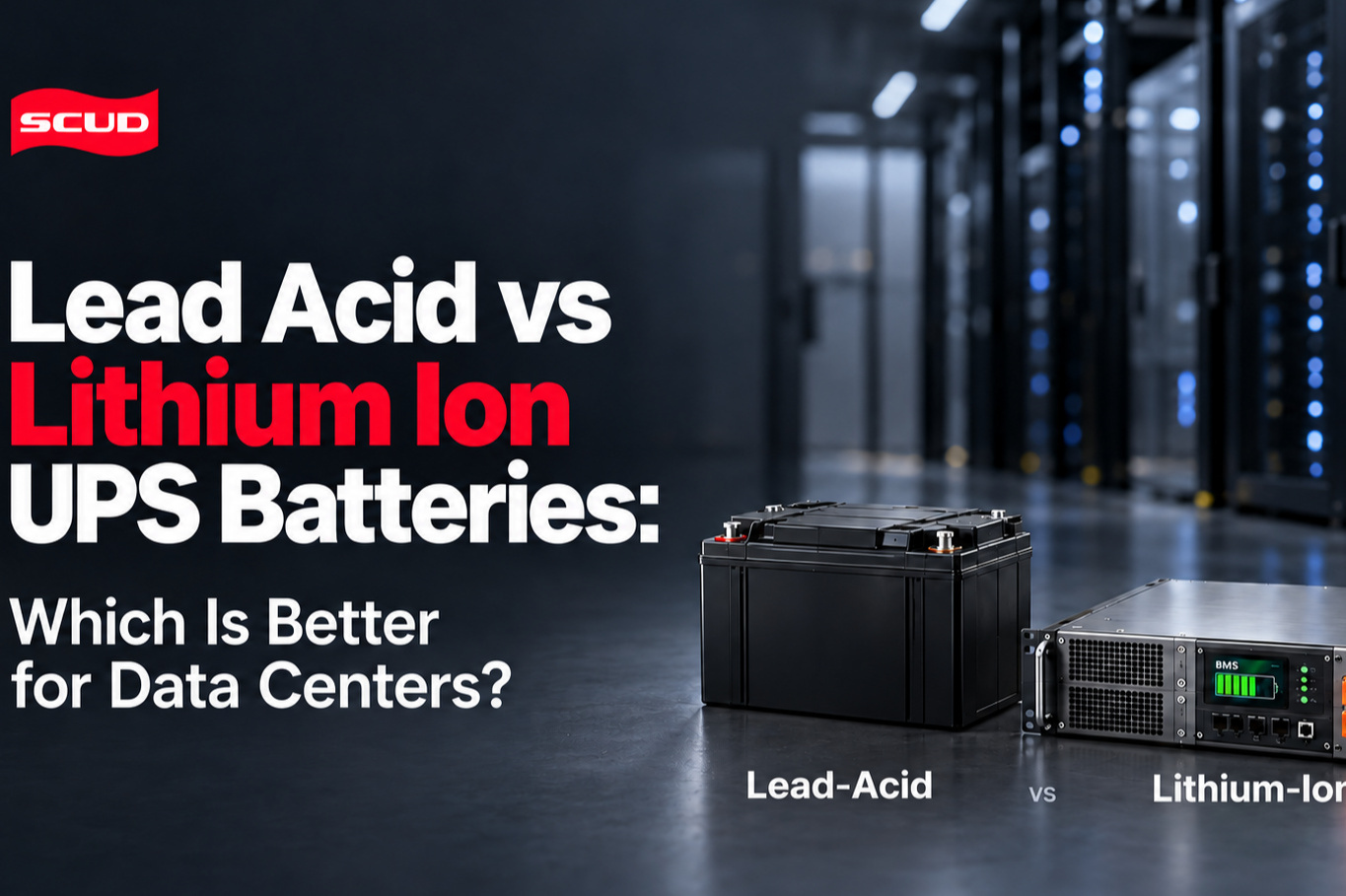
Lead Acid vs Lithium Ion UPS Batteries: Which Is Better for Data Centers?
Lead-acid batteries offer familiar, often lower-cost backup power for data centers. Lithium-ion brings compelling advantages in space, weight, and recharge performance, plus longer replacement intervals in qualified designs. The right choice balances those gains against maintenance needs and UPS compatibility, so neither technology is universally better.
This article examines lead-acid vs lithium-ion UPS batteries to help infrastructure teams and OEMs compare operating performance, lifecycle costs, and integration requirements when planning custom battery packs.
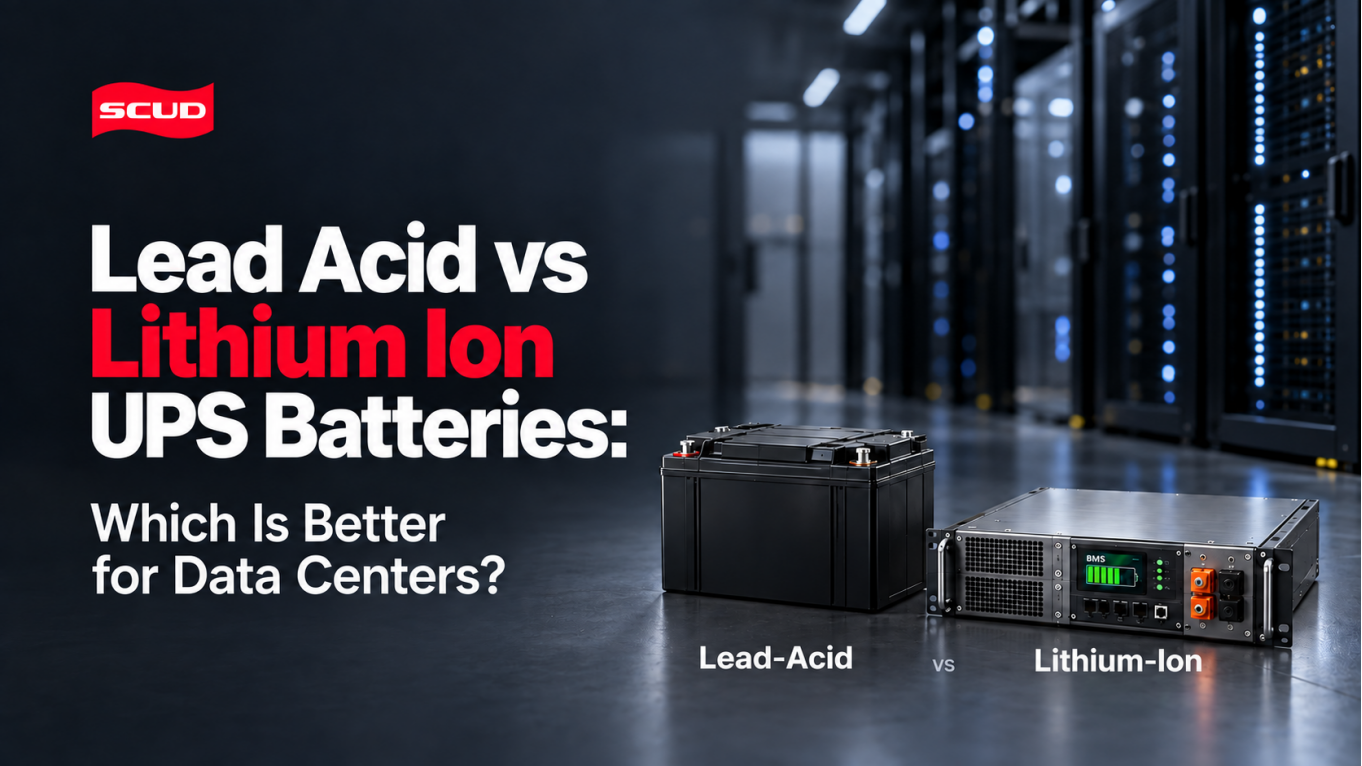
Alt: Lead-acid battery vs lithium-ion UPS battery
Lead Acid vs Lithium Ion UPS Batteries at a Glance
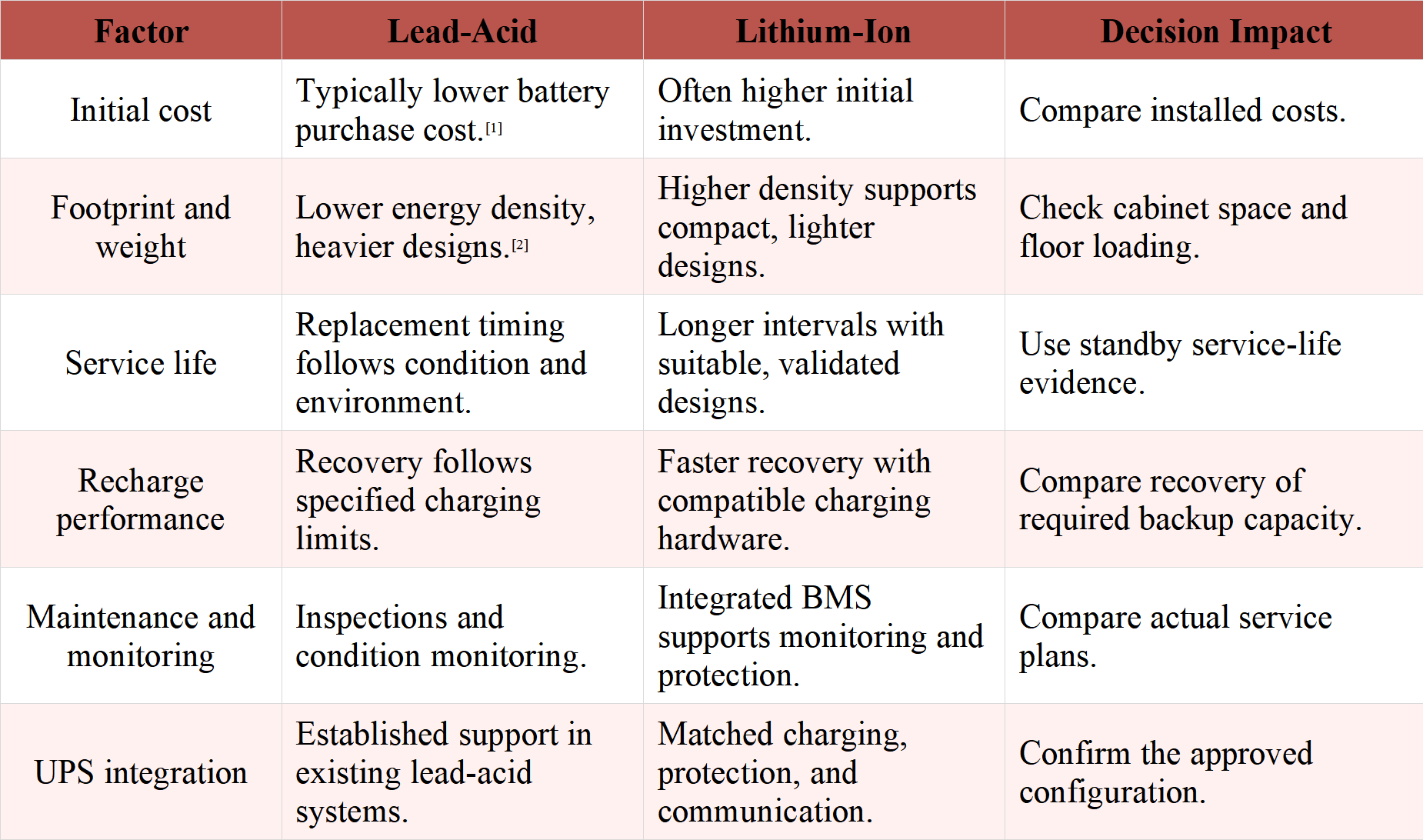 Note: In this UPS comparison, lead-acid refers to valve-regulated lead-acid (VRLA) batteries.[2]
At the same backup power and runtime, lead-acid's main strength is its affordability and compatibility with established systems. Lithium-ion UPS batteries offer a more compact, lighter installation, with faster recovery and potential for fewer replacements. That combination becomes especially valuable when space is scarce and the project will operate for many years.
Lead Acid vs Lithium Ion: What Are the Key Operational Differences?
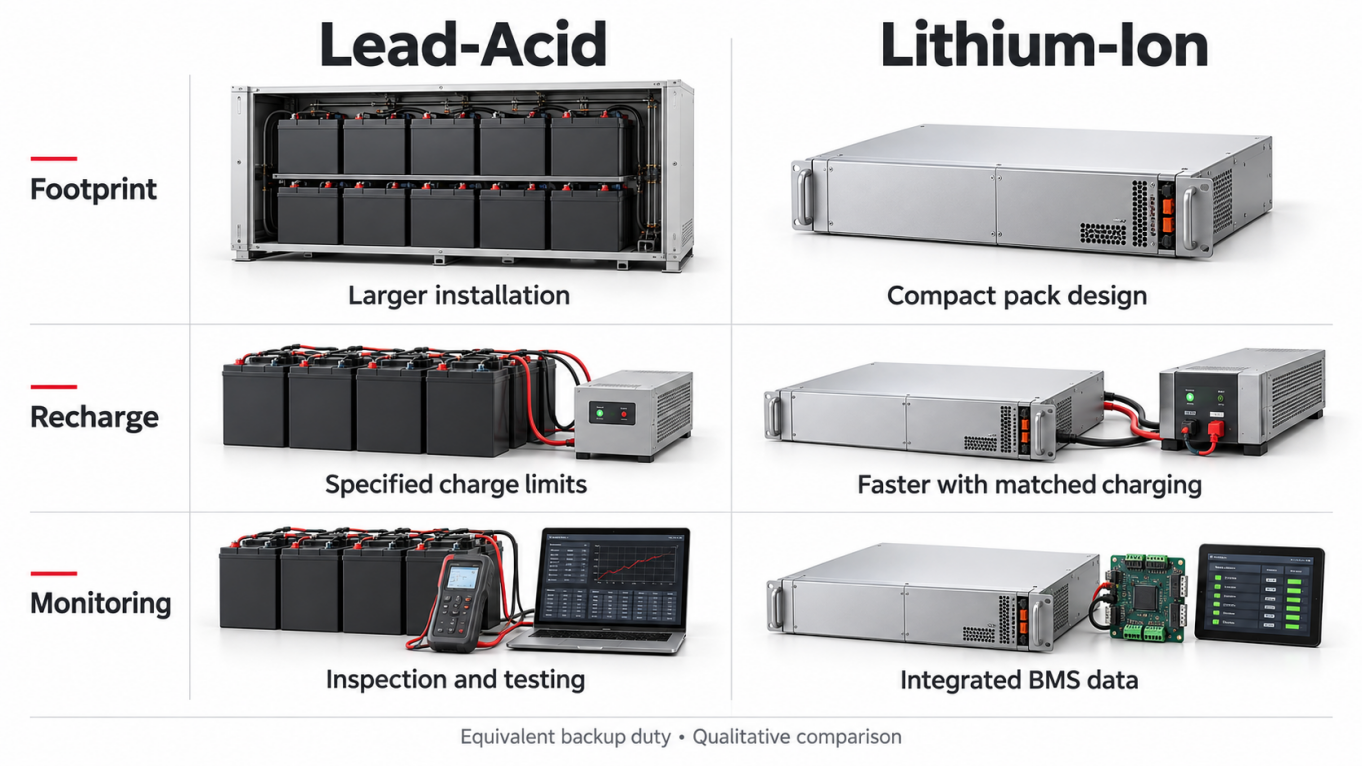
Alt: Lead-acid vs lithium-ion UPS battery operational differences
Five operating differences shape the installation's space needs, backup recovery, and maintenance workload:
1. Footprint and Weight
· Lead-Acid: For a comparable energy requirement, lower energy density generally means more cabinet space and a heavier installation.
· Lithium-Ion: Higher energy density supports smaller, lighter packs.[2] Designers of custom lithium-ion battery packs can use that advantage to fit the enclosure, cooling provisions, and service access into a tighter equipment layout.
2. Service Life and Replacement Cycles
· Lead-Acid: Standby batteries age even when outages are rare, and elevated temperature accelerates capacity loss.[1] Replacement therefore follows condition and service history.
· Lithium-Ion: A design qualified for longer standby service reduces the frequency of planned battery changes. Its calendar-aging performance under the intended conditions is more useful here than a cycle-life figure alone.
3. Charging Speed and Recovery Time
· Lead-Acid: Recharge time follows the battery's specified charging limits, which constrain how quickly lost backup capacity is restored.
· Lithium-Ion: Suitable designs accept higher charging currents,[2] restoring backup capacity sooner when paired with a compatible charger and charging profile.
4. Temperature and Cooling Requirements
· Lead-Acid: Service life is sensitive to elevated temperatures, making temperature control important to preserving capacity and managing replacement intervals.
· Lithium-Ion: Greater temperature flexibility in suitable designs creates opportunities to reduce battery cooling demand.[1] The benefit depends on the qualified cell range and the pack's heat dissipation.
5. Monitoring, Maintenance, and Safety Management
· Lead-Acid: Scheduled inspections, testing, and condition monitoring help operations teams track deterioration and identify service needs.
· Lithium-Ion: An integrated BMS combines battery status data with alarms and protective controls. Alongside electrical and installation safeguards,[3] it gives maintenance teams continuous information for targeted checks and timely fault response.
These operating gains matter most when they ease real site constraints. Their financial value becomes clearer when space, service work, and replacement events are costed over the same operating period.
Which UPS Battery Offers Better Total Cost of Ownership?
Lead-acid can offer lower total cost of ownership (TCO) when a site can reuse compatible equipment and expects few replacements during its operating period. Lithium-ion becomes more competitive when reduced replacement work and installation demands outweigh its higher initial cost. A fair lead-acid battery vs lithium-ion battery comparison covers the complete operating period.[4] Five cost categories make that assessment practical:
· Battery purchase cost: The starting figure is the complete battery system sized for the required load and runtime, including protection and monitoring.
· Installation and infrastructure cost: Cabinets, handling, structural provisions, electrical work, and commissioning all affect installed cost. Compact battery pack designs offer value where space or floor loading constrains installation.
· Maintenance cost: Inspection labor, testing, monitoring services, and fault response accumulate over time. Proposed service schedules and support arrangements determine this part of the budget.
· Cooling and operating cost: Battery thermal requirements and local energy prices drive cooling cost. This item is separate from UPS conversion losses and overall facility HVAC consumption.
· Replacement and downtime cost: Replacement batteries, removal, disposal, and scheduling belong in the lifetime budget. Any disruption cost depends on redundancy and service arrangements, since a planned battery change does not automatically require an outage.
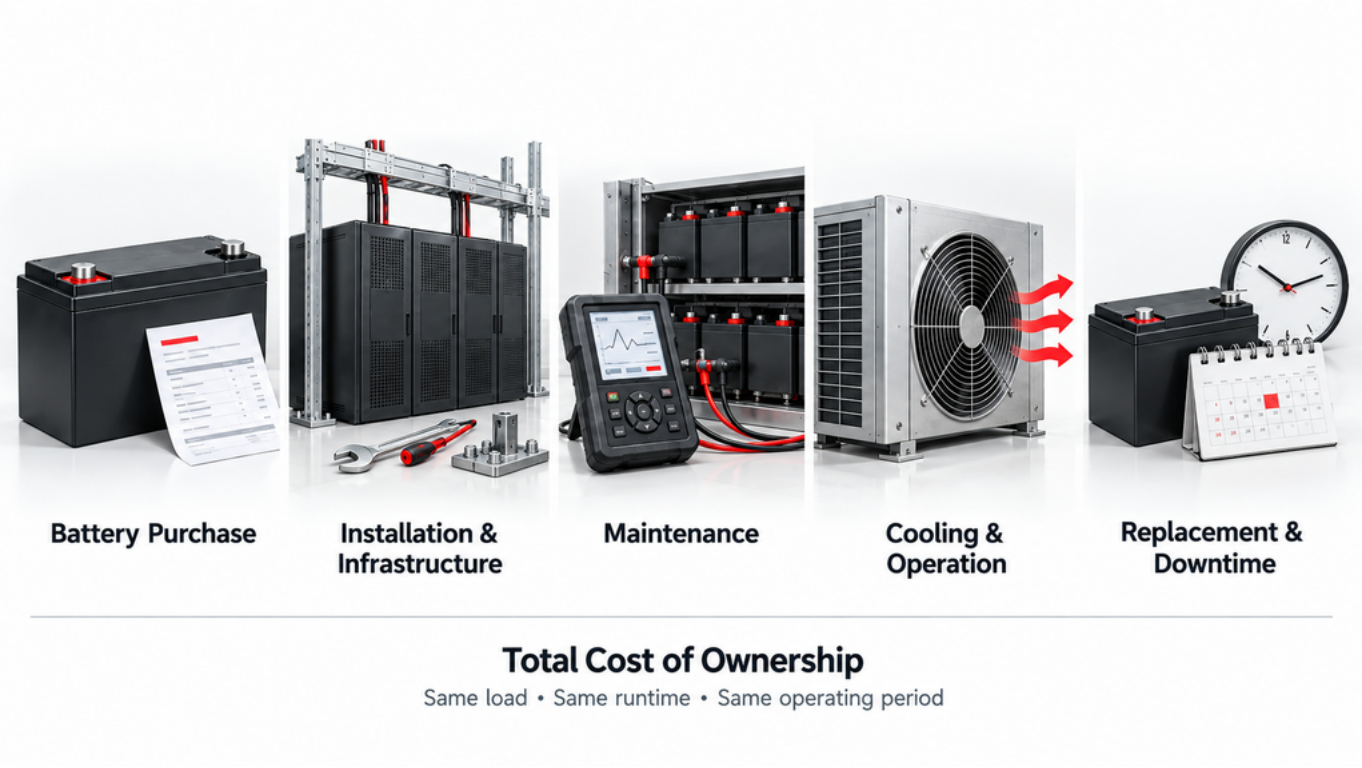
Alt: UPS battery total cost of ownership components
Installed quotations and a realistic replacement timeline bring UPS battery total cost of ownership into focus. Together, they capture the value of equipment already on site and the future work a battery-only price leaves out.
Which UPS Battery Is Right for Different Data Center Scenarios?
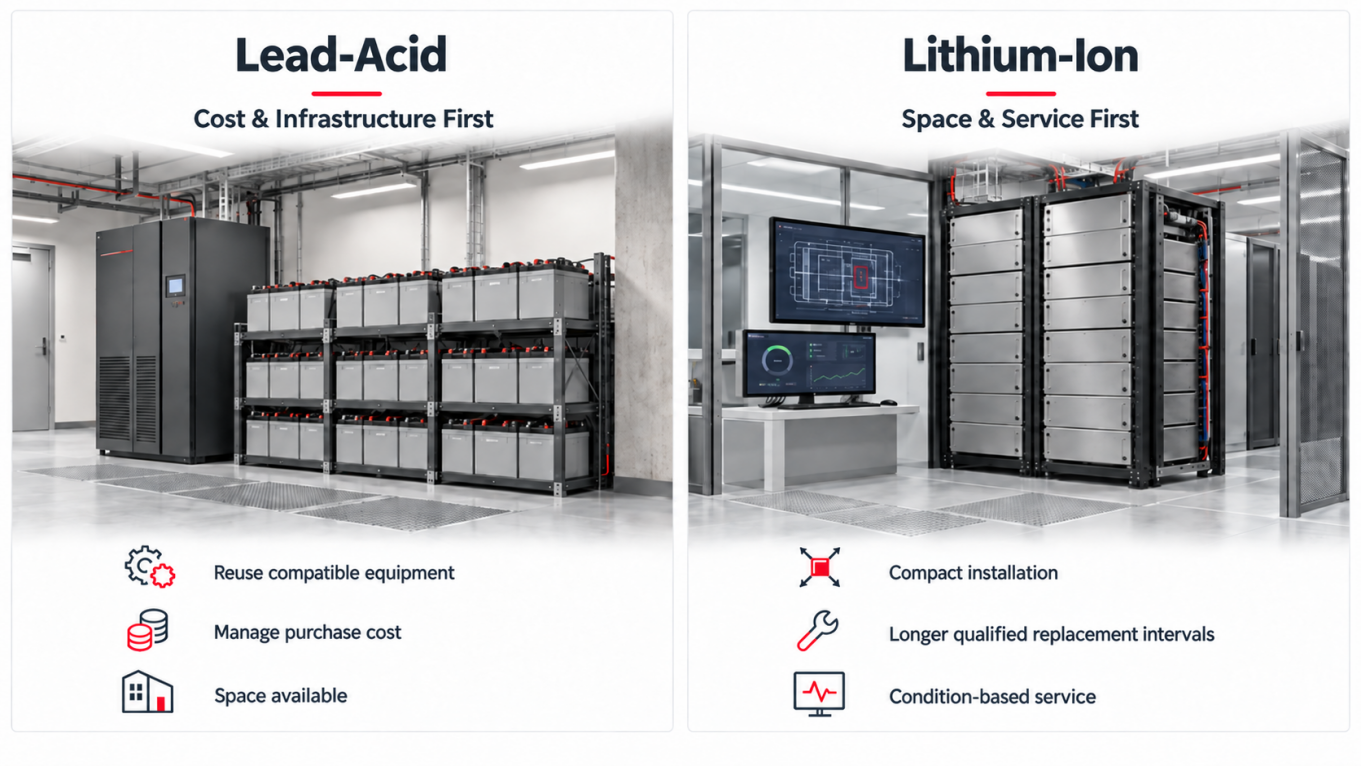
Alt: Lead-acid and lithium-ion UPS battery selection priorities
Site priorities turn the comparison into a clearer choice for existing installations and new projects:
Lead-Acid Is a Practical Choice When
· Initial cost dominates: A constrained budget favors the lower installed quote, provided service requirements remain manageable.
· The existing UPS supports lead-acid: Retaining the approved configuration limits changes to charging and protection equipment.
· Space and weight are not limiting: Adequate room and structural capacity reduce the value of a smaller battery installation.
Lithium-Ion Suits Projects That Prioritize
· Space efficiency and lower weight: Lithium-ion UPS battery packs support compact layouts where installation space is valuable.
· Longer replacement intervals: A long operating horizon strengthens the case when the proposed design's service-life evidence supports fewer replacement events.
· Preventive maintenance: Integrated condition data and alarms help operations teams identify developing issues and plan service.
For an OEM building a new UPS platform, custom lithium-ion battery packs allow these priorities to inform the enclosure, electrical configuration, and interfaces from the outset. That opportunity is strongest when the pack and UPS are developed as a coordinated system.
What to Check Before Selecting or Upgrading a UPS Battery System
Before placing an order, verify five areas with the UPS supplier, battery developer, and integration team:
1. UPS and charger compatibility: Confirm the supported configuration, voltage window, charging current, and control strategy. Matching nominal voltage alone does not establish direct-replacement compatibility.
2. Voltage, capacity, and runtime: Validate backup duration against load, discharge limits, temperature, and aging allowance. Ampere-hour capacity alone does not establish runtime at the UPS output.
3. BMS and communication: Agree on interfaces for status, alarms, charge limits, and protective actions, including responses to communication faults.
4. Space, cooling, and installation: Check dimensions, floor loading, heat rejection, cable access, and maintenance clearances for the finished installation.
5. Testing, certification, and lifecycle support: Define validation, market-specific compliance, documentation, and service responsibilities. Cell certification alone does not establish pack or system compliance.
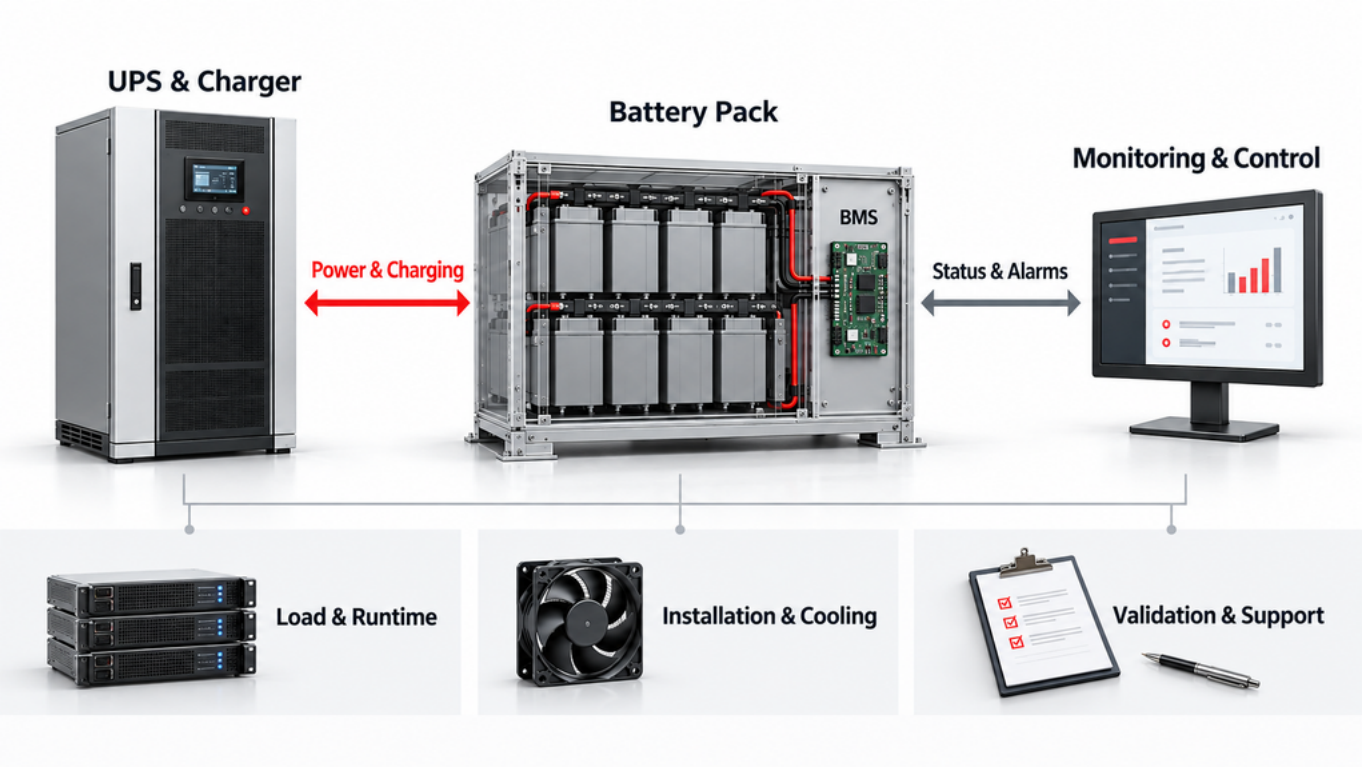
Alt: UPS battery power, BMS, and integration requirements
For OEMs, a dependable battery-pack manufacturer connects these requirements with engineering, testing, and production. A documented development plan gives the UPS team a clear basis for evaluating the proposed lithium-ion solution and moving it toward deployment.
Develop Custom Lithium-Ion Battery Packs with SCUDPower
When lithium-ion fits the project's priorities, a purpose-built pack helps put those advantages to work within the UPS platform. SCUDPower brings custom battery development and manufacturing together, helping OEMs move from initial requirements to production.
Our custom battery packs serve industrial UPS and data center BBU applications, each with its own load profile and integration needs. We support these projects with:
· A pack shaped around your backup duty: Cell selection and electrical configuration start with the required power and runtime, so the design addresses the equipment's actual backup task.
· Controls that work with your platform: BMS hardware, firmware, and communication development align battery status, alarms, and control functions with the agreed system interfaces.
· Better use of available space: Mechanical and thermal design coordinate the enclosure, structural needs, and heat dissipation, so a compact pack also fits the equipment's installation and service requirements.
· Evidence for design qualification: In-house testing covers performance, environmental reliability, and safety, alongside prototype verification and certification support. This provides documented evidence for the project's design and compliance reviews.
· A path from prototype to repeatable production: Tooling, sample validation, and pilot production establish how the design will be built and checked at scale, giving OEMs a practical route from tested samples to repeatable manufacturing.
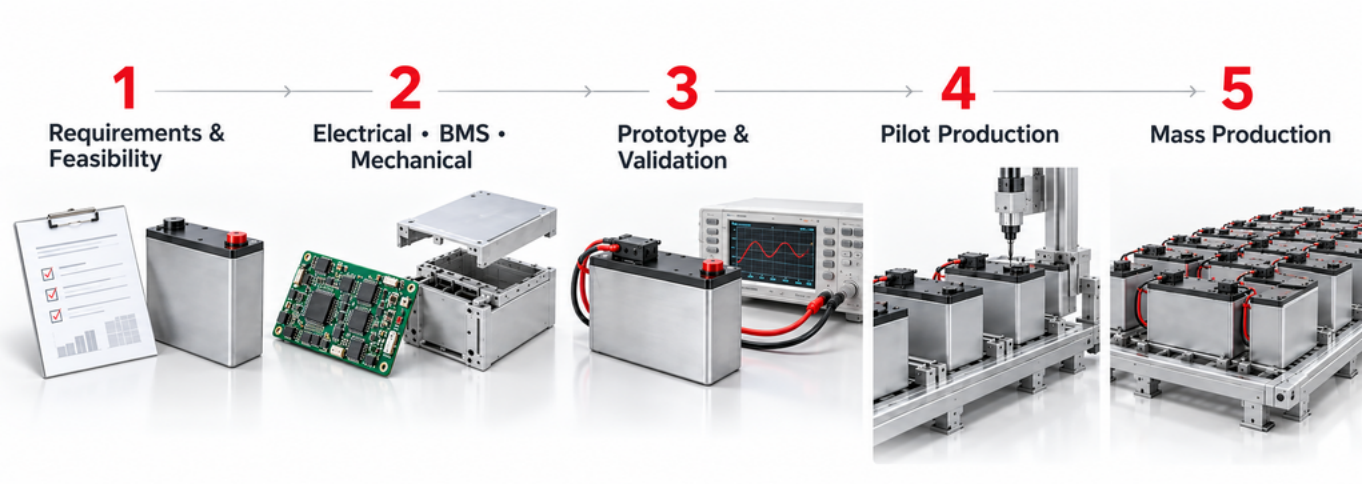
Alt: SCUDPower custom battery development workflow
Planning a new UPS platform or a supported battery upgrade? We can help connect your voltage, capacity, and runtime targets with the communication, installation, and compliance requirements that shape the finished pack. Contact SCUDPower to explore custom lithium-ion battery packs with a team that can take the project from feasibility review through production.
FAQ
Are lead-acid or lithium-ion batteries better for UPS systems?
Lead-acid is often a practical choice for compatible, cost-sensitive installations. Lithium-ion is stronger where space, weight, faster recovery, or longer qualified replacement intervals matter, provided the UPS supports the proposed pack. The decision follows the complete installation's requirements.
Can an existing lead-acid UPS use lithium-ion batteries?
Yes, if the UPS supplier supports the proposed lithium-ion configuration and the battery has been validated for that system. The charger, protection, and communication must work together with the pack, so matching nominal voltage alone does not establish compatibility. For an OEM project, discuss your battery integration requirements with SCUDPower.
Do lithium-ion UPS batteries require maintenance?
Yes. Integrated BMS monitoring helps operations teams identify issues, while scheduled inspections, alarm review, and checks of cooling, connections, and protection keep the installation properly maintained. The service plan should follow the battery and UPS suppliers' instructions.
What information is needed to develop a custom UPS battery pack?
The useful starting point is the load profile, target runtime, and UPS/charger specifications. Voltage, capacity, installation space, operating environment, communication, and applicable compliance requirements complete the brief. SCUDPower's pack feasibility review helps translate that information into custom battery packs for the agreed project requirements.
References
[1] Henke, M., and Hailu, G. (2020). Thermal Management of Stationary Battery Systems: A Literature Review. Energies, 13(16), 4194. http://doi.org/10.3390https://www.scudpower.net//about.html13164194
[2] Stan, A.-I., Swierczynski, M. J., Stroe, D. I., Teodorescu, R., Andreasen, S. J., and Moth, K. (2014). A Comparative Study of Lithium Ion to Lead Acid Batteries for use in UPS Applications. Proceedings of the IEEE INTELEC Conference, pp. 1-8. http://doi.org/10.1109/INTLEC.2014.6972152
[3] U.S. Department of Energy. (2024). Energy Storage Safety Strategic Plan. Section 4.4. http://www.energy.gov/sites/default/files/2024-05/EED_2827_FIG_SafetyStrategy%20240505v2.pdf
[4] Van Geet, O., and Sickinger, D. (2024). Best Practices Guide for Energy-Efficient Data Center Design. National Renewable Energy Laboratory, U.S. Department of Energy Federal Energy Management Program. Revised July 2024. http://www.energy.gov/sites/default/files/2024-07/best-practice-guide-data-center-design.pdf