


21700 vs 18650 Batteries: Key Differences for Custom Battery Packs


SHARE
SHARE

21700 vs 18650 Batteries: Key Differences for Custom Battery Packs
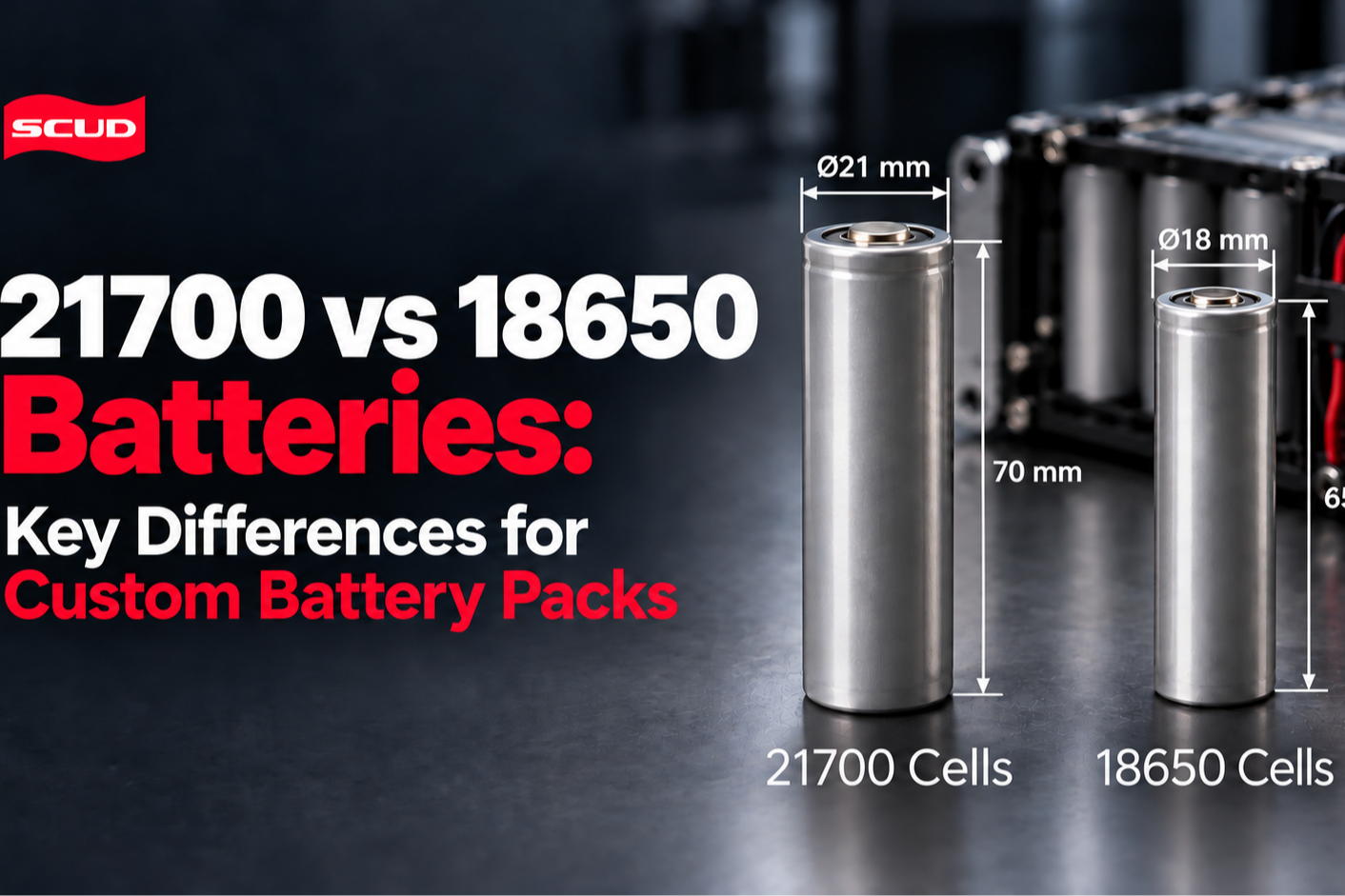
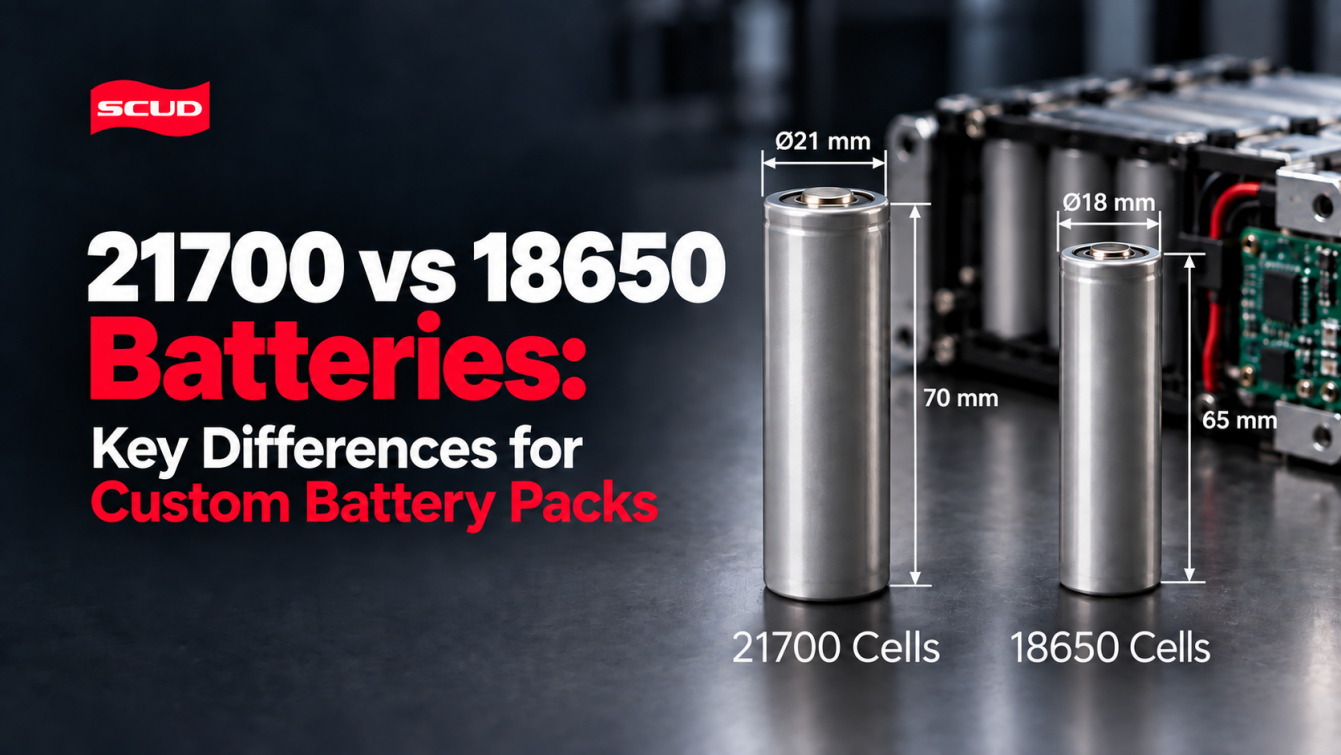
21700 cells generally offer more energy per cell, while 18650 cells provide smaller building blocks for constrained layouts and established platforms. Neither cylindrical lithium-ion format is universally better for custom battery packs. The right choice balances the load, available space, thermal conditions, manufacturing requirements, and existing product design. This article examines 21700 vs 18650 batteries to help OEM engineering and procurement teams connect cell selection with a practical pack design.
Alt: 21700 vs 18650 batteries for custom battery packs
21700 vs 18650 Batteries at a Glance
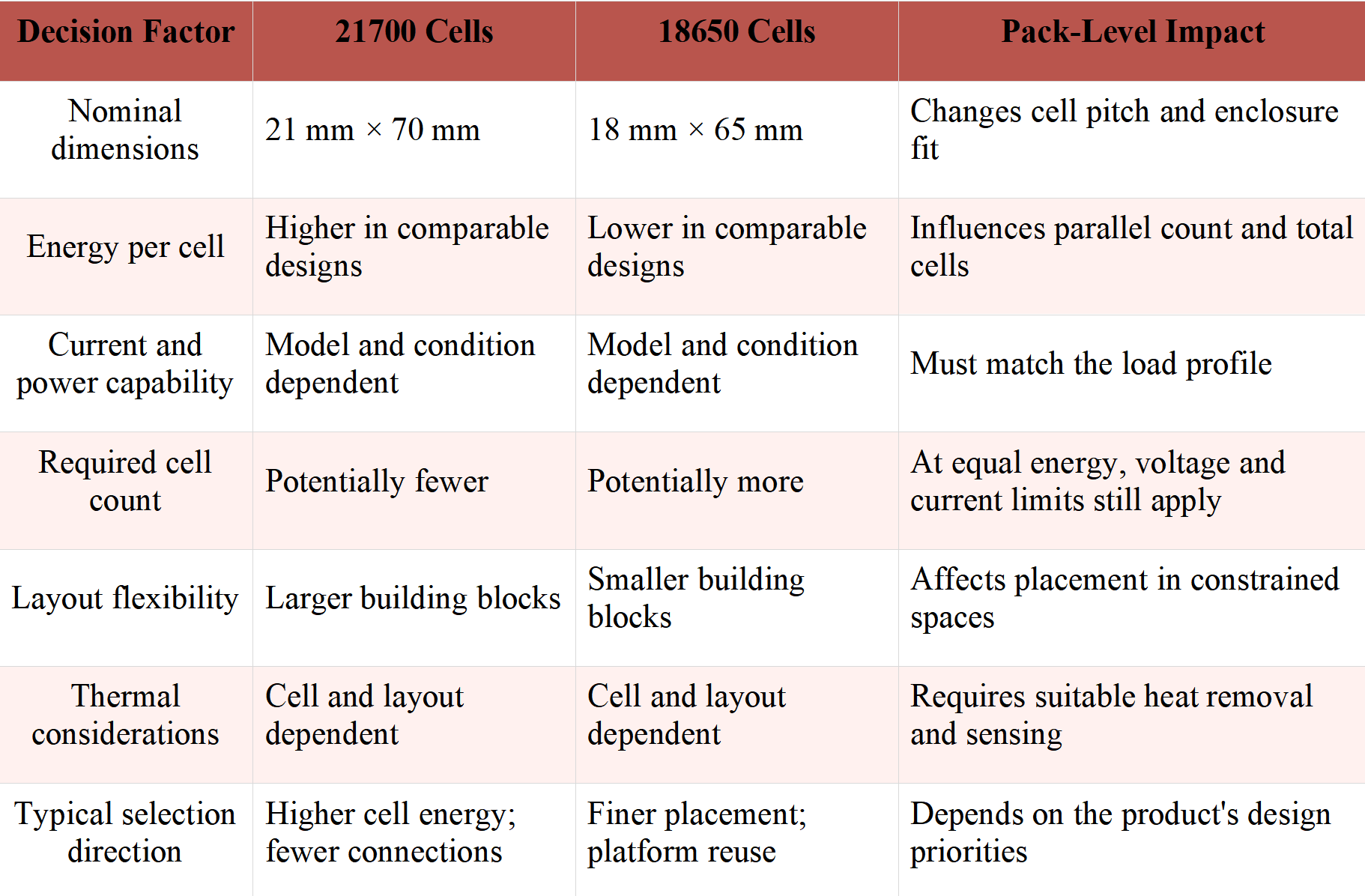
Note: Dimensions are nominal diameter × length values. Use the selected cell's drawing and tolerances for mechanical design.
The main trade-off is higher energy in each cell versus smaller units that fit more flexibly. For custom battery packs, the benefit comes from meeting electrical and mechanical requirements in one design.
21700 vs 18650 Batteries: How Does Cell Performance Compare?
Cell performance depends on usable energy, output under load, and behavior over repeated cycles. The following four comparisons distinguish format-related advantages from model-specific results:
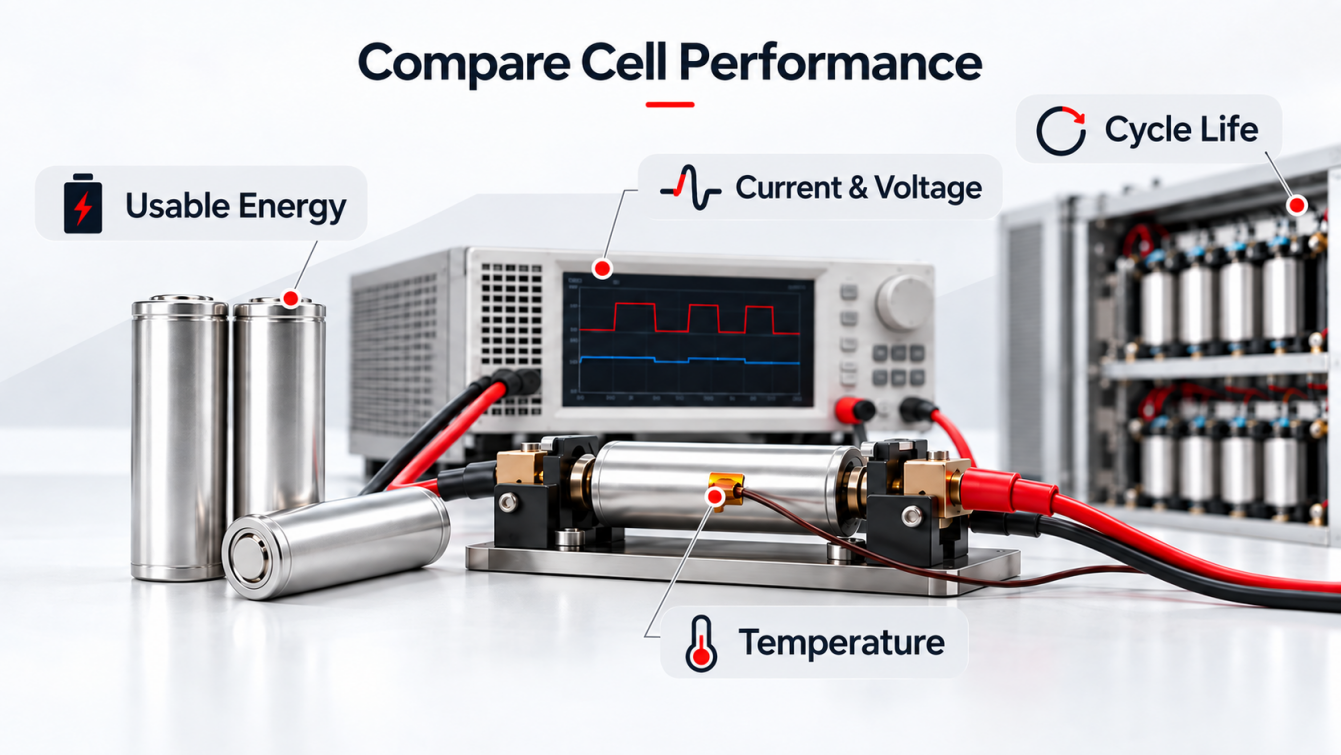
Alt: Battery cell performance evaluation
21700 Cells Offer More Energy in Comparable Designs
· 21700 cells: More space for active material generally provides higher capacity and energy with comparable chemistry and electrode design.[1]
· 18650 cells: The smaller active volume stores less energy per cell under those same design assumptions.
Usable energy at the intended discharge current and cutoff voltage shows how much of a 21700 cell's capacity advantage translates into equipment runtime.
Current Ratings Determine Sustained and Peak Output
· 21700 cells: At the same permitted C-rate, a higher-capacity model provides a higher discharge current in amperes.
· 18650 cells: A lower-capacity model needs a higher permitted C-rate to match that current.
The practical comparison uses rated continuous and peak currents in amperes, including peak duration and temperature limits. Continuous ratings support steady operation; power tools also need suitable pulse capability for loads such as repeated motor starts.
Lower Resistance Improves Voltage Retention under Load
A matched pilot-cell study[1] measured AC resistance at 1 kHz:
· 21700 samples: Lower resistance than the matched 18650 samples.
· 18650 samples: Higher resistance under the same measurement conditions.
Under operating load, lower effective resistance reduces voltage drop and resistive heating. Discharge curves at comparable temperature and state of charge show which commercial model maintains the voltage the equipment needs.
Heat Removal and Cycling Conditions Shape Service Life
In a base-cooling test[2] of one model per format, using optimized electrical connections:
· 21700 sample: Rejected more total heat for a given temperature difference.
· 18650 sample: Rejected more heat per unit of cooled area in the same experiment.
Temperature rise reflects both heat generated at the operating current and heat removed through the cooling path. Matched 21700 and 18650 pilot cells showed similar capacity fade when cycled at 1C and 25°C.[1]
Taken together, higher energy per cell is the clearest 21700 advantage in comparable designs. Power, service life, and safety depend on the chemistry, cell model, and operating conditions. The stronger candidate combines sufficient usable energy with the current capability, voltage retention, and cycling performance the equipment needs.
How Do 21700 and 18650 Cell Sizes Affect Custom Battery Packs?
The size difference changes how cells are combined, placed, monitored, and assembled. For custom lithium-ion battery packs, these effects connect the cell comparison to the electrical configuration, physical layout, and production design.
Higher Cell Capacity Can Reduce the Parallel Cell Count
The target voltage window and chemistry largely determine the series count, while parallel cells provide the required capacity and current. Consider a hypothetical 36 V, 12 Ah pack using 3.6 V cells:
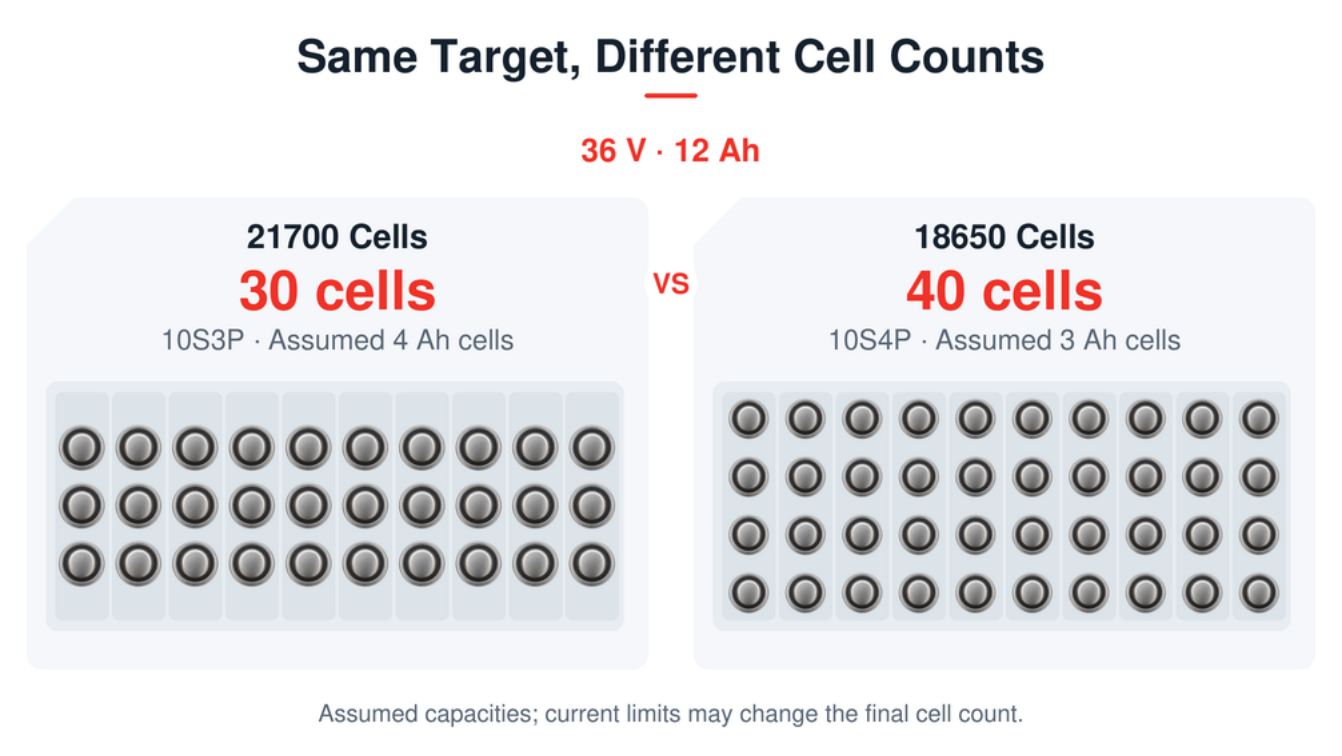
Alt: 21700 vs 18650 cell counts for a 36 V, 12 Ah pack
· 21700 cells: Assumed 4 Ah cells give a 10S3P configuration with 30 cells.
· 18650 cells: Assumed 3 Ah cells give a 10S4P configuration with 40 cells.
The 21700 example reaches the capacity target with fewer cells, but each carries more current at the same pack load. If its current limit requires another parallel cell per group, the configuration must increase accordingly.
Cell Dimensions Set the Layout and Cooling Space
· 21700 cells: The larger diameter and height require more space per cell and holder in a 21700 battery pack.
· 18650 cells: Smaller units allow finer placement increments in narrow or irregular spaces.
Holders, insulation, busbars, connectors, and cooling clearances occupy additional space. The better fit is the complete assembly that accommodates these components within the enclosure.
Cell Configuration Guides BMS Protection and Sensing
· Voltage monitoring: Both configurations in the 10S example require monitoring of ten series groups, despite their different total cell counts.
· Protection limits: For the 10S3P and 10S4P options, BMS overcurrent settings must suit the selected cells and the validated current capability of the complete pack.
· Temperature sensing: Changing between larger 21700 cells and smaller 18650 cells changes the layout and potential heat-accumulation locations, affecting sensor placement.
Fewer Cells Can Reduce Assembly Work and Cost
· 21700 cells: Fewer cells can mean fewer joints to weld and inspect when higher capacity reduces the parallel count.
· 18650 cells: A higher cell count adds connections, but existing holders, fixtures, and validated assembly processes can favor platform reuse.
Custom battery design must also account for cell purchasing, prototype validation, and final testing costs to establish the finished pack's cost.
A lower cell count helps when it reduces assembly work while meeting the product’s current, space, thermal, and protection requirements. The gain should also justify any changes to tooling and validation. Comparing complete 21700 and 18650 pack designs on this basis shows which option delivers the more practical balance of electrical performance, packaging, and manufacturing cost.
21700 vs 18650: Which Battery Cell Fits Your Project?
Once both options meet the electrical requirements, enclosure constraints, production priorities, and the scope for redesign help determine which format is the better fit:
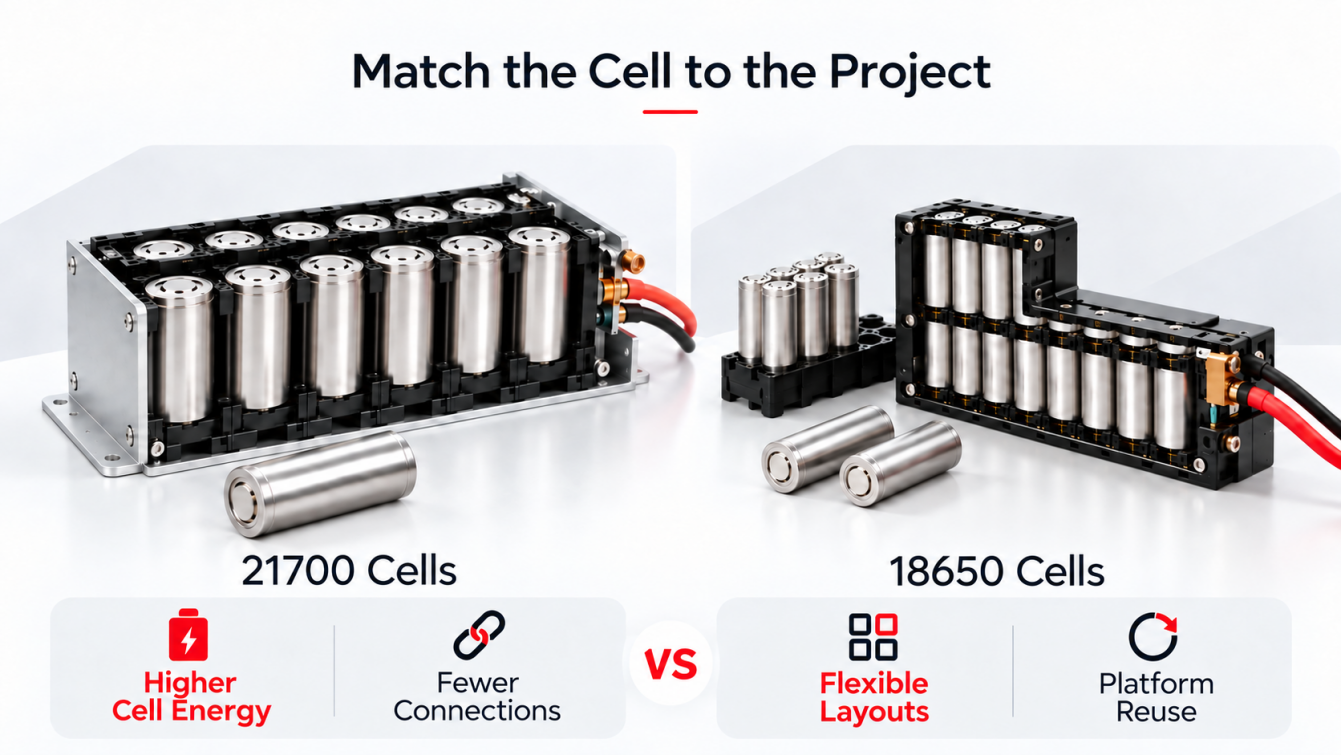
Alt: 21700 vs 18650 pack design priorities
Choose 21700 Cells When the Design Benefits from Fewer, Larger Cells
· The energy target can be met with fewer parallel cells while staying within the selected cell's current limits.
· The enclosure has room for the larger cells, their holders, and the required cooling clearances.
· Reducing the number of connections to assemble and inspect is a production priority.
Choose 18650 Cells When Layout Flexibility or Platform Reuse Matters
· Narrow or irregular internal spaces favor smaller cells that can be placed more flexibly.
· Smaller capacity increments help match the energy target to the available layout.
· Existing fixtures and product validation are built around an 18650 architecture, making retention valuable unless a redesign offers sufficient benefits.
What to Check Before Selecting 21700 or 18650 Cells
A useful brief for lithium-ion battery sizing connects the electrical load with the enclosure and operating conditions, providing a consistent basis for these six checks:
1. Specify the required voltage range, usable energy, and runtime, including the duty cycle and an allowance for capacity loss with aging.
2. Describe continuous, peak, and pulse loads in amperes, with their durations and repetition intervals.
3. Provide usable enclosure dimensions and weight limits, allowing for mounting points, clearances, and the finished assembly.
4. Confirm the exact cell model and supplier qualification, including traceability and controls for cell substitutions.
5. Document ambient temperatures and environmental exposure, including vibration, moisture, and the available heat-removal path.
6. Agree on BMS protection and communication, validation tests, and market-specific certification requirements for the finished pack.
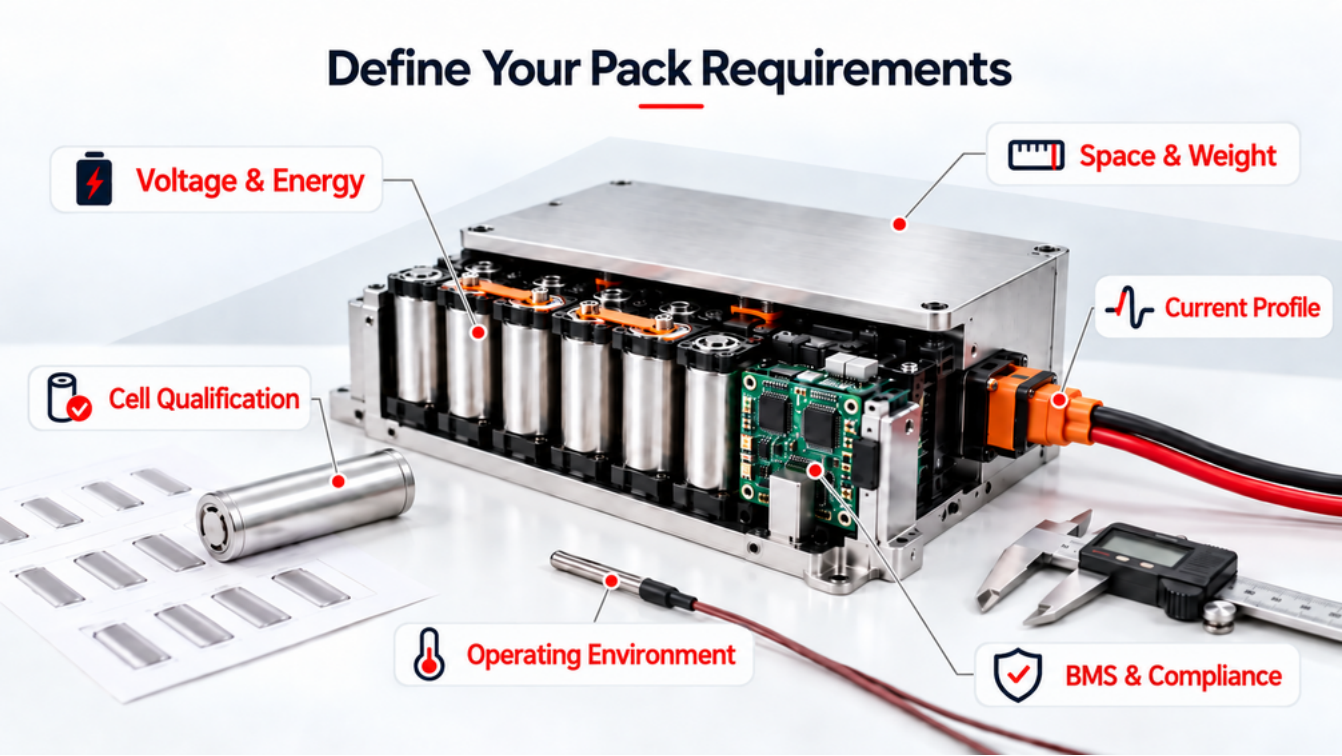
Alt: Six custom battery pack design requirements
A capable custom battery-pack manufacturer should turn this brief into a feasible design, verify it with prototypes, and support production validation.
Develop Custom Lithium Battery Packs with SCUDPower
SCUDPower brings electrical, software, mechanical, process, and test expertise into one custom battery-pack development program. Our application experience spans light electric vehicles, cleaning equipment and power tools, personal and home goods, AGV and robotics, UPS and BBU systems, and medical devices.

Alt: SCUDPower battery application areas
We support OEM projects with:
· A clearer starting point: Requirements and feasibility reviews align the proposed battery with product constraints and cost targets.
· Cell selection tied to the application: We evaluate the 21700 vs 18650 choice alongside the electrical configuration and actual load requirements. Our product range includes the RD08 power bank with 21700 cells and the CR004 robot-cleaner battery with 18650 cells in a 4S2P configuration.
· Coordinated integration: BMS development and mechanical design are reviewed together with the thermal requirements, helping align the pack's electrical and physical interfaces.
· Evidence before production: Prototype verification, reliability testing, and certification testing support assessment of the proposed design.
· A planned path to scale: Tooling samples, pilot production, and production validation connect design development with mass production.
See SCUDPower's automated battery production.
Whether your project favors 21700 cells or 18650 cells, we can help turn that selection into a coordinated development plan. Contact SCUDPower to discuss custom lithium-ion battery packs designed around your equipment and project requirements.
FAQ
Are 21700 batteries better than 18650 batteries?
Neither format is universally better. 21700 cells often provide more energy per cell, while 18650 cells offer smaller dimensions for constrained layouts. The better choice depends on the specific cell model, load profile, enclosure, cooling, and existing platform.
Can a 21700 battery replace an 18650 battery?
Usually, no. The larger diameter and length of a 21700 cell generally require a different holder or pack layout. Its charging and protection requirements must also match the system, and the revised assembly needs validation even when nominal voltage matches.
Does a 21700 battery pack require fewer cells?
Yes, if higher usable energy lets you use fewer parallel cells while still meeting current demand. Series count remains tied to the voltage requirements and chemistry. The useful result is a complete configuration that delivers the required energy and current within the available space.
Which cell format is better for a compact battery pack?
21700 cells can help reduce cell count, while 18650 cells can fit narrow or irregular spaces more flexibly. The more compact finished pack depends on the complete layout, including insulation, connectors, cooling, and the current each cell must carry.
What information is needed for a custom lithium battery pack design?
Provide the voltage range, energy or runtime target, current profile, available dimensions, and weight limits. Communication, operating environment, and certification requirements also help define the design. SCUDPower uses these inputs to assess feasibility and plan custom battery packs around the product's electrical and mechanical requirements.
References
[1] Waldmann, T., Scurtu, R.-G., Richter, K., & Wohlfahrt-Mehrens, M. (2020). 18650 vs. 21700 Li-ion cells – A direct comparison of electrochemical, thermal, and geometrical properties. Journal of Power Sources, 472, 228614. http://doi.org/10.1016/j.jpowsour.2020.228614
[2] Marzook, M. W., Hales, A., Patel, Y., Offer, G., & Marinescu, M. (2022). Thermal evaluation of lithium-ion batteries: Defining the cylindrical cell cooling coefficient. Journal of Energy Storage, 54, 105217. http://doi.org/10.1016/j.est.2022.105217