How to Choose the Best Lithium Battery BMS for Custom Packs


SHARE
SHARE

How to Choose the Best Lithium Battery BMS for Custom Packs
Selecting a battery management system (BMS) for lithium batteries starts with the pack and equipment it must serve. A well-matched lithium battery BMS supports required power delivery, battery-state information, and device integration. For OEM engineers developing custom battery packs, this article explains how to translate a load profile into BMS requirements, evaluate supplier evidence, and plan a solution for robotics, micromobility, or other industrial applications.
Lithium battery BMS for custom packs
What Defines the Best Lithium Battery BMS?
The best lithium battery management system meets the pack's operating requirements and remains practical to integrate, validate, and manufacture. Four factors define that fit:
Selection Factor | What to Specify | Why It Matters |
Electrical compatibility | Chemistry, series count, voltage range, and load profile | Matches monitoring and current handling to actual operation |
Protection and state management | Fault responses, state estimation, and balancing | Supports controlled operation and usable battery information |
System integration | Communication, firmware behavior, and installation requirements | Makes battery data and controls usable by the host device |
Validation and production control | Test evidence, approved configurations, and traceable changes | Links sample approval to repeatable production and later revisions |
A higher current rating addresses only one part of selection. The strongest fit meets all four requirements within the intended product architecture.
How to Match a Lithium Battery BMS to Your Pack and Load Profile
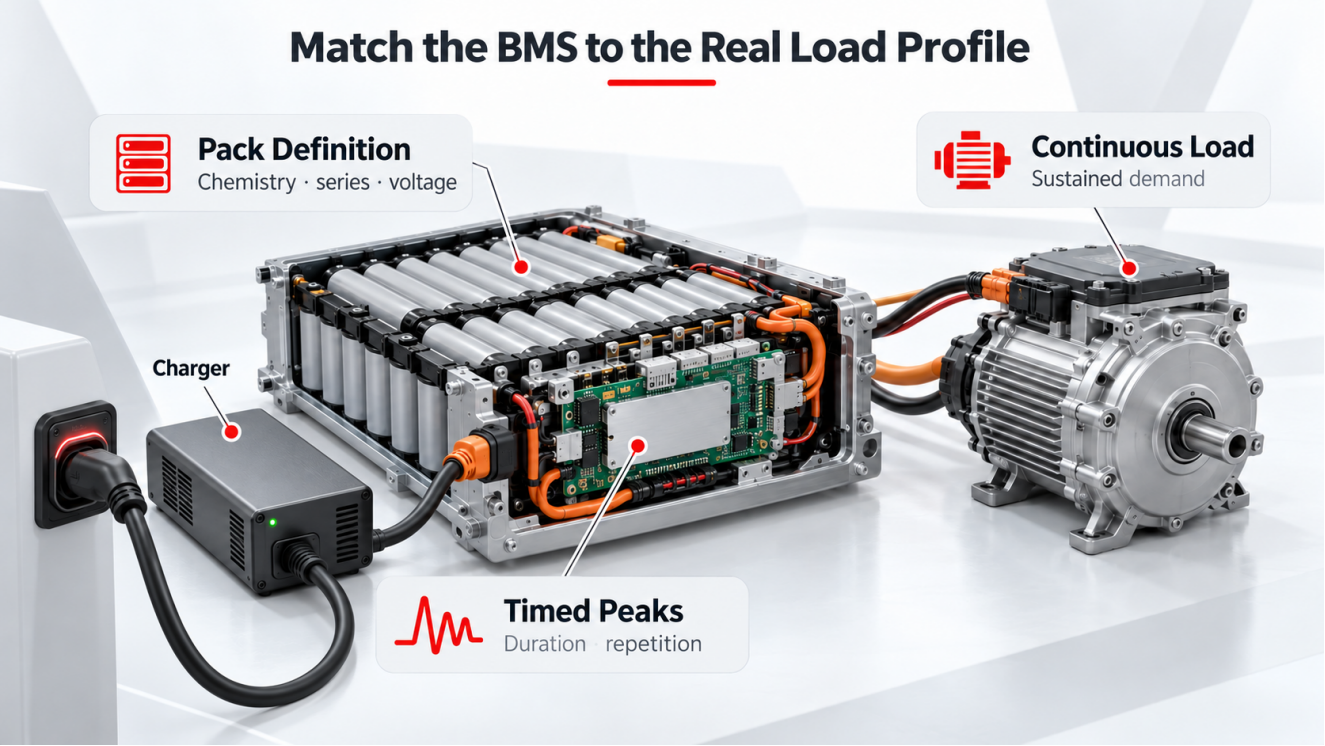
Match the BMS to the pack's electrical limits and actual operating pattern. The load profile should distinguish normal operation, short bursts, and charging events, with the conditions under which each occurs.
BMS load and charging requirements
Match Cell Chemistry, Series Count, and Voltage Limits
Start with three parts of the pack definition:
· Cell chemistry and series count. Match chemistry-specific voltage limits and the number of monitored cell groups. The full operating voltage range also determines component ratings and protection settings.
· Capacity and service-life targets. Define capacity and runtime alongside parallel configuration. State the charging pattern, depth of discharge, and temperature associated with the cycle-life target.
· Voltage variants. Identify the hardware and approved parameters for each series configuration so platform variants remain distinct during development.
Size for Continuous Loads and Timed Current Peaks
Continuous current describes sustained demand, while peak current needs a duration and repetition rate. A motor-start or AGV acceleration surge places different demands on the pack from carrying that current continuously.
For a concrete pack specification, SCUDPower's electric motorcycle battery Model 9745 is rated for 150 A continuous discharge and a 300 A peak for 3 seconds. The 3-second peak duration gives BMS developers a defined burst to assess against protection timing. At the same time, the cells, current path, and thermal design must be evaluated for both sustained and peak loads.
Account for Fast Charging and Regenerative Current
Fast charging and regenerative braking require a defined charging envelope as well as discharge capability. Permissible regenerative current depends on cell temperature, state of charge, and the charge quantity involved.[1] Specify both:
· Regenerative pulses: current, duration, repetition, and coordination with the motor controller.
· Repeated fast charging: charging current, frequency, temperature conditions, and the cycle-life target under that duty cycle.
Together, these inputs define which load and charging events the pack is intended to support. They give the BMS developer a basis for distinguishing normal operation from a fault and selecting the functions needed to manage both.
Which BMS Functions Matter for Custom Battery Packs?
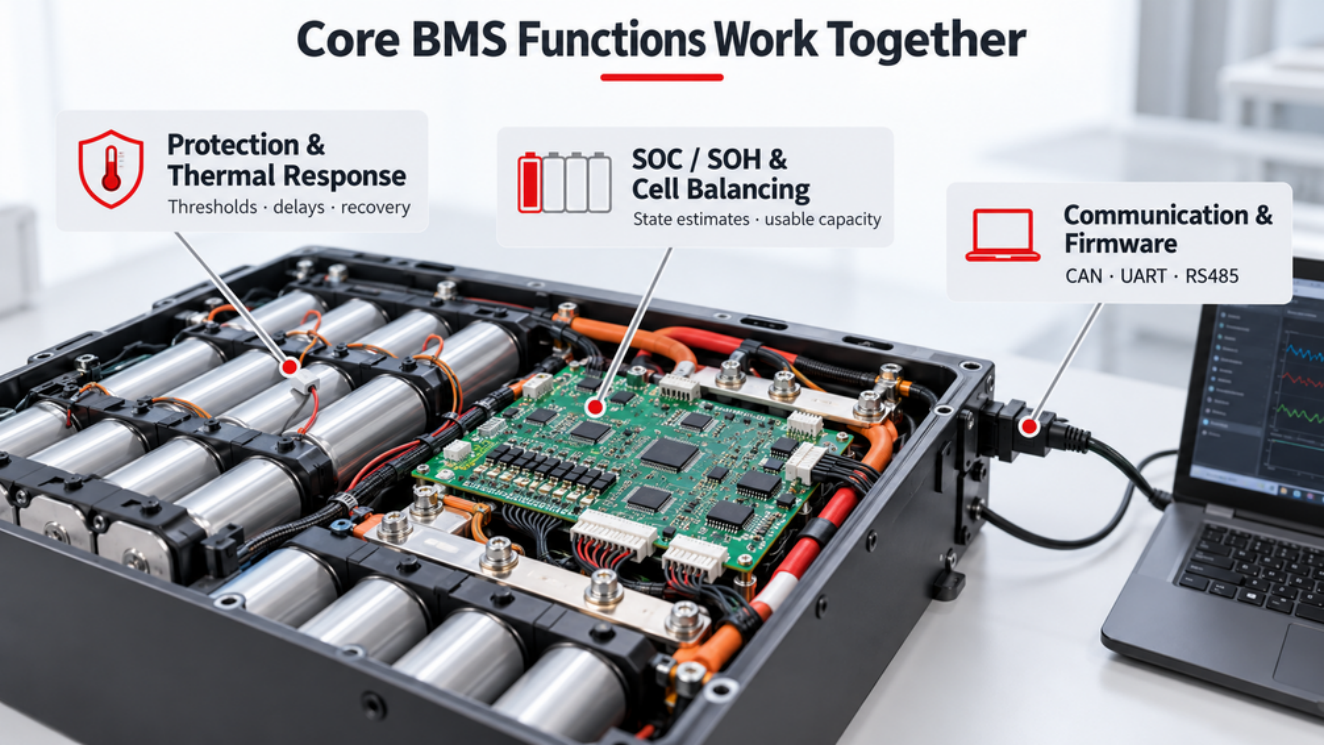
Battery management system design connects protection, battery-state information, and communication to the product's operating requirements. For custom battery packs, three groups of functions matter most:
BMS protection, monitoring, balancing, and communication
Protection and Thermal Response
A BMS monitors electrical and temperature conditions so the system can respond to overvoltage, undervoltage, overcurrent, and temperature faults.[2] Effective protection connects each detected condition to a defined response:
· Set thresholds, response delays, and recovery conditions around the selected cells and permitted load events.
· Place temperature sensing where it captures relevant cell and power-component heating, with charge/discharge restrictions appropriate to those readings.
SOC/SOH Monitoring and Cell Balancing
State of charge (SOC) indicates remaining charge, while state of health (SOH) describes aging-related changes in battery condition.[2] When selecting a BMS for a lithium-ion battery, evaluate SOC/SOH monitoring against the selected cells and operating profile to support runtime planning and maintenance.
Cell balancing addresses differences between series-connected cell groups. Choose the balancing method and current around expected imbalance, available balancing time, and heat constraints. The goal is to keep cell-group differences from unnecessarily limiting usable pack capacity.
Communication and Firmware Integration
Communication should give the controller usable battery data and predictable fault behavior. For CAN, UART, or RS485 interfaces, define two sets of integration details:
· The communication specification: data units, update intervals, fault codes, and the response to interrupted communication.
· Firmware and service behavior: application-specific tuning, diagnostic logging, and permitted parameter changes so updates preserve the approved operating behavior.
These decisions belong in custom BMS development, where the communication map and firmware behavior are specified together.
These functions work together in the finished device: protection governs responses to faults, state information supports operation, and communication makes both accessible to the host controller.
How to Evaluate a BMS Supplier for Custom Battery Packs
Evaluate battery management system manufacturers and pack developers on their engineering support, verification evidence, and production controls. Four checks help distinguish a proposed feature set from a solution ready for your application:
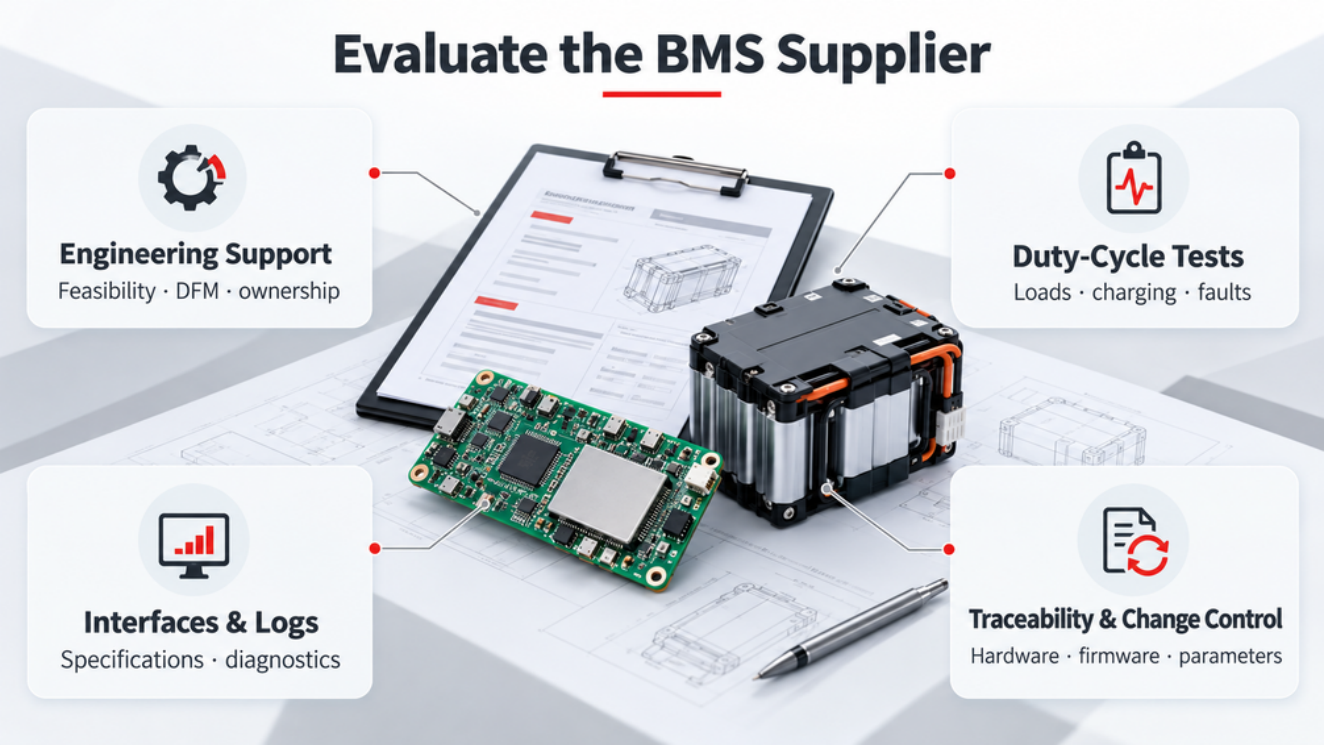
BMS supplier engineering and validation checks
1. Engineering support before design commitment. Request a feasibility review and design for manufacturing (DFM) assessment of your drawings and load profile, covering cell selection, BMS architecture, and manufacturing constraints. Agree on who owns hardware, firmware, and integration decisions.
2. Tests that represent the intended duty cycle. Ask for conditions and results covering continuous loads, timed peaks, charging, and fault responses. Include regenerative pulses and repeated fast charging where the application requires them.
3. Documented interfaces and diagnostic records. Obtain communication specifications, representative BMS logs, and agreed tools for accessing operating and fault data. Establish which records will be available during development and service.
4. Traceable configurations and controlled changes. Confirm links between cell batches, pack identities, test records, and approved hardware, firmware, and parameters. Keep records for each voltage variant, with documented approval and revalidation of relevant changes.
Compare proposals against the same acceptance criteria and agree on deliverables before sample approval. This establishes what a production partner must reproduce and which changes will require further review.
Start Custom BMS and Battery Pack Engineering with SCUDPower
A custom pack program needs a partner that can turn the load profile into working electronics, firmware, and a manufacturable battery. At SCUDPower, we develop custom lithium-ion battery packs for micromobility, cleaning equipment and power tools, personal and home devices, AGV and robotics, UPS and BBU systems, and medical equipment. We support BMS selection and development through:
· Architecture decisions resolved together. Our electronic, software, mechanical, process, and test engineers assess feasibility, cell selection, and BMS architecture alongside enclosure and manufacturing needs.
· Controls matched to the host device. Our custom BMS design covers protection, SOC/SOH monitoring, balancing, and CAN/UART integration. Modular software platforms and OTA support provide a basis for application-specific firmware development.
· Verification connected to production readiness. Prototype verification, reliability testing, and small-scale production reviews assess the design before mass production. Laboratory workflows upload test data to MES, supporting test traceability.
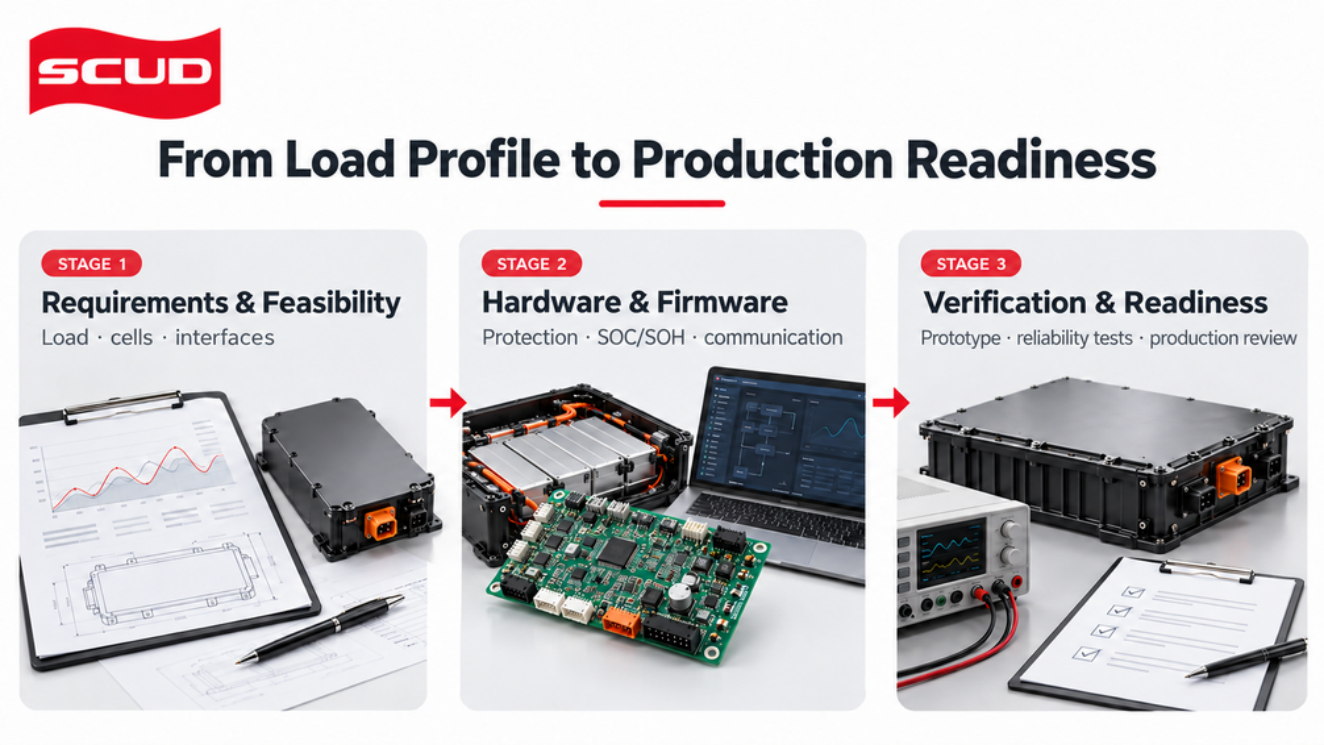
SCUDPower custom BMS and battery pack development
For OEMs refining an early drawing or planning another voltage variant, our team helps connect BMS behavior with the complete product requirements. Contact SCUDPower to discuss a lithium battery BMS and custom pack development plan for your application.
FAQ
What Is a BMS for a Battery?
A battery management system for lithium-ion batteries monitors cell voltages, current, and temperature to support protection and pack control. Depending on the design, it also provides state estimation and balancing configured for the selected cells and device requirements.
Can One BMS Support Several Pack Voltages?
Yes, if its hardware supports the required series counts and voltage ranges. Each variant still needs its own approved configuration and validation; changing nominal voltage can affect monitoring, protection, and component ratings.
Can a BMS Alone Enable Regenerative Braking or Repeated Fast Charging?
No. Those functions require coordination among the cells, BMS, charger or motor controller, and thermal design. Ask for validation of the actual charging pulses and repeated duty cycle, not just a maximum current rating.
Which Custom Battery Manufacturer Can Help With Pack and BMS Development?
SCUDPower supports combined pack and BMS development through interdisciplinary engineering and staged verification. Its custom development capabilities support feasibility assessment, cell selection, and BMS architecture for OEMs starting with drawings or an initial load profile.
References
[1] Grimsmann, F., et al. (2017). Determining the maximum charging currents of lithium-ion cells for small charge quantities. Journal of Power Sources, 365, 12–16. https://doi.org/10.1016/j.jpowsour.2017.08.044
[2] Gabbar, H. A., Othman, A. M., & Abdussami, M. R. (2021). Review of Battery Management Systems (BMS) Development and Industrial Standards. Technologies, 9(2), 28. https://doi.org/10.3390/technologies9020028