UN38.3 vs IEC 62133-2: A Battery Compliance Checklist


SHARE
SHARE

UN38.3 vs IEC 62133-2: A Battery Compliance Checklist
UN38.3 addresses lithium battery transport testing, while IEC 62133-2 covers safety requirements for portable rechargeable lithium cells and batteries. They serve different purposes, so passing one does not replace the other.[1][2] For OEMs developing custom battery packs, the challenge is connecting the right requirements with the design, supporting evidence, and shipment plan. This guide explains the differences and provides a battery compliance checklist to help engineering, quality, and procurement teams prepare for production and delivery.
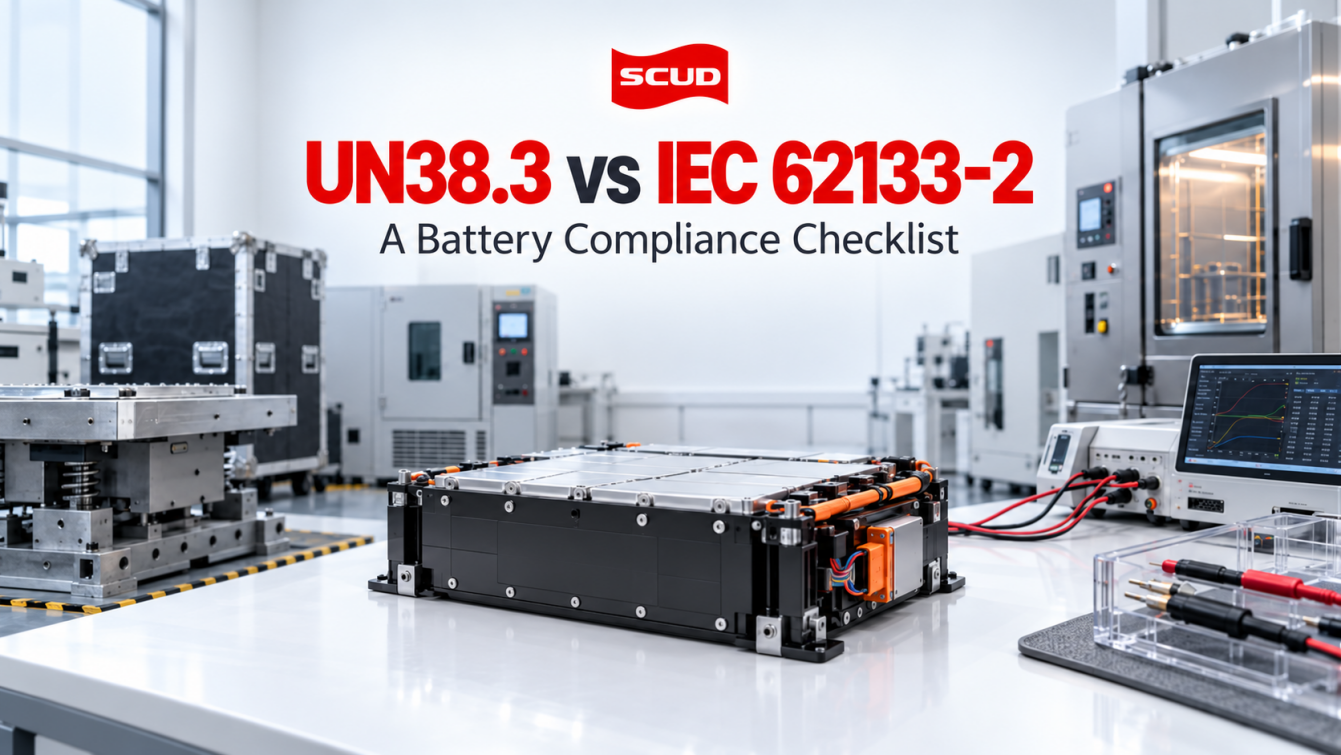 UN38.3 vs IEC 62133-2 battery compliance
UN38.3 vs IEC 62133-2: What’s the Difference?
Comparison Point | UN38.3 | IEC 62133-2 |
Purpose | Establish transport-related safety test performance | Assess safety during intended use and reasonably foreseeable misuse |
Relevant Scope | Lithium metal and lithium-ion cell and battery types | Portable sealed rechargeable lithium cells and batteries |
Assessment Focus | Applicable transport tests, including altitude, thermal, vibration, shock, and electrical stresses | Product safety requirements and tests within the standard’s portable-application scope |
Typical Evidence | UN38.3 test summary supported by the underlying test report | Test report and certification documents for the chosen conformity route |
What It Does Not Cover | Complete shipping compliance or approval for every end use | Transport qualification or approval of the complete device |
For custom battery packs used in portable devices, UN38.3 addresses transport-related stresses, while IEC 62133-2 evaluates safety in use. A project may need both, along with the applicable shipping and market requirements.[1][2]
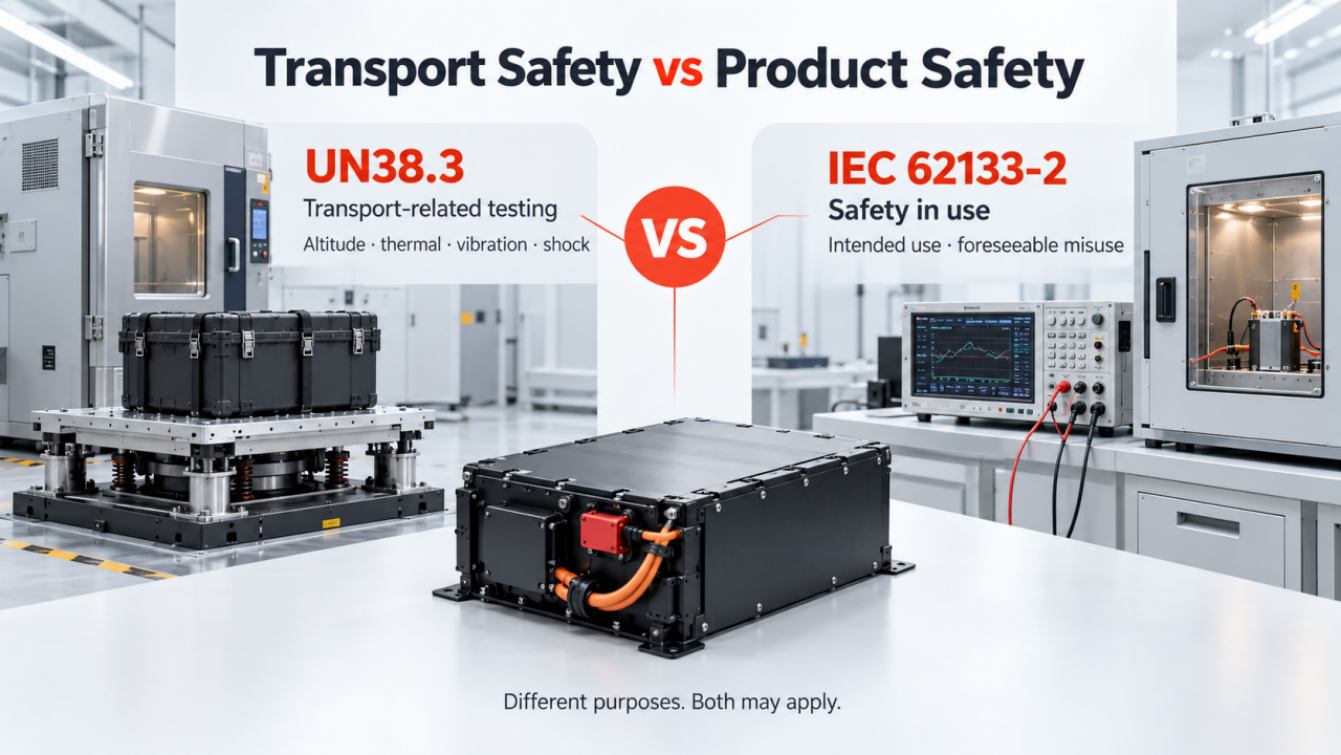 UN38.3 transport safety vs IEC 62133-2 product safety
Which Battery Safety Standards Apply to Your Project?
IEC 62133-2 applies to portable rechargeable lithium cells and batteries, while industrial and vehicle packs need their own application-specific assessment.[2] Choosing lithium-ion battery testing standards also depends on the destination market:
· Portable rechargeable lithium packs: Assess IEC 62133-2 and the applicable regional adoption, including the relevant EN version where required. Confirm the accepted edition with the laboratory or certification body.[2]
· Industrial batteries, including AGV packs and UPS batteries: IEC 62619 addresses industrial lithium applications, including stationary backup and certain motive uses. Application-specific standards can take precedence.[3]
· Light electric vehicles: Evaluate the battery and vehicle electrical system separately. For relevant North American projects, UL 2271 and UL 2272 are examples of battery-level and system-level standards. European projects require their own market and vehicle-integration assessment.[4]
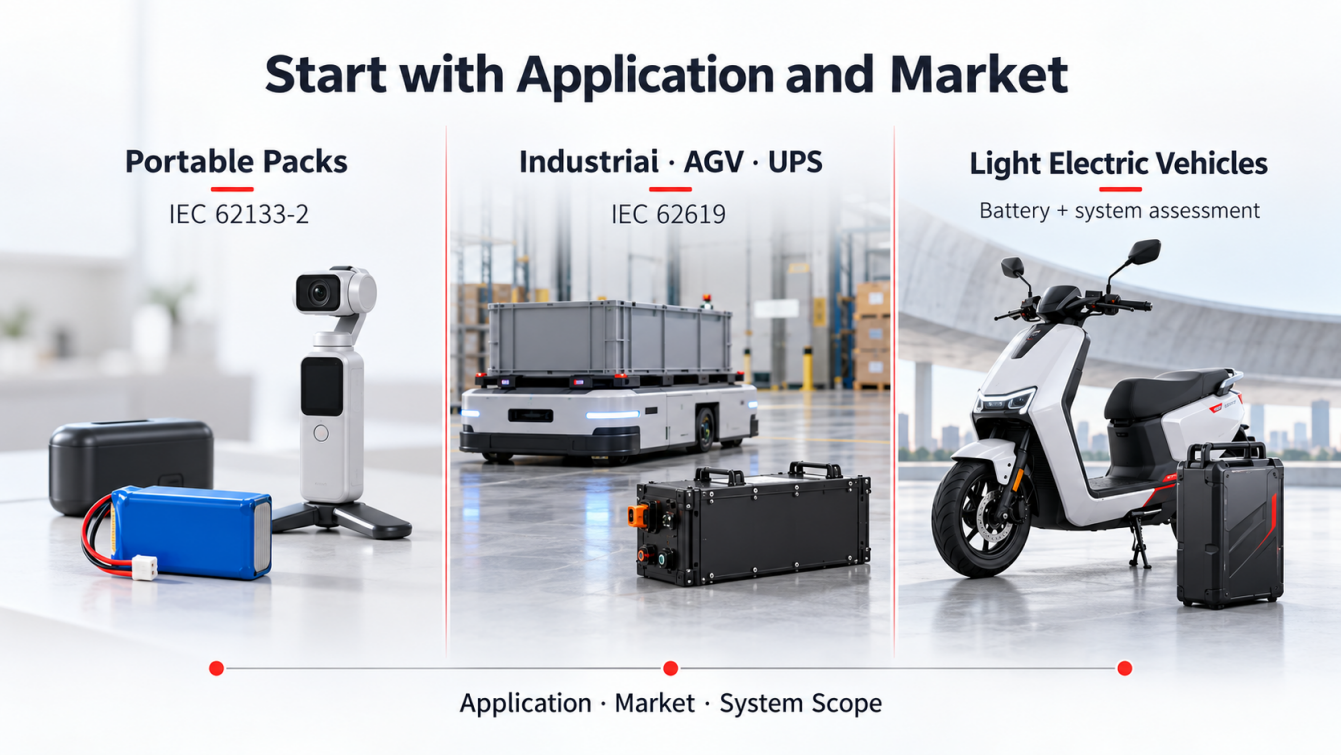
Battery standards by application and market
Once the application and target market are clear, the supplier’s document package should show how the proposed battery meets those specific requirements.
What Documents Should You Request from a Custom Battery Manufacturer?
Request the UN38.3 test summary, supporting test reports, and applicable market-compliance documents from your custom battery manufacturer. The table below explains what each document demonstrates and which details to verify:
Evidence | Purpose | What to Verify |
UN38.3 battery test summary and underlying report | Test summary for supply-chain checks; UN38.3 test report for detailed review | Manufacturer/model, laboratory, report number/date, ratings, tests/results, and UN Manual edition[5][8] |
IEC 62133-2 report and applicable certification documents | Demonstrate assessment against the selected product-safety requirements | Pack identification, edition, tested configuration, and any CB documents if that route is chosen |
EU conformity documentation | Support applicable CE-marking obligations | Relevant legislation, technical documentation, and EU declaration of conformity; distinguish battery from equipment obligations[6] |
Material-compliance records | Address applicable substance restrictions and procurement requirements | Battery-law obligations, any relevant equipment/component RoHS scope, and agreed material declarations[7] |
Shipment-specific documents | Support the actual transport arrangement | Correct classification, shipping description, and dangerous-goods declaration where required for the mode and configuration |
Note on RoHS: Batteries themselves are outside RoHS scope. Check battery substance restrictions separately from any RoHS obligations for associated equipment.[7]
Note on UN38.3 documents: A safety data sheet or general compliance statement does not replace a UN38.3 test summary.[5] Agree to provide access to the underlying report separately for technical review.[8]
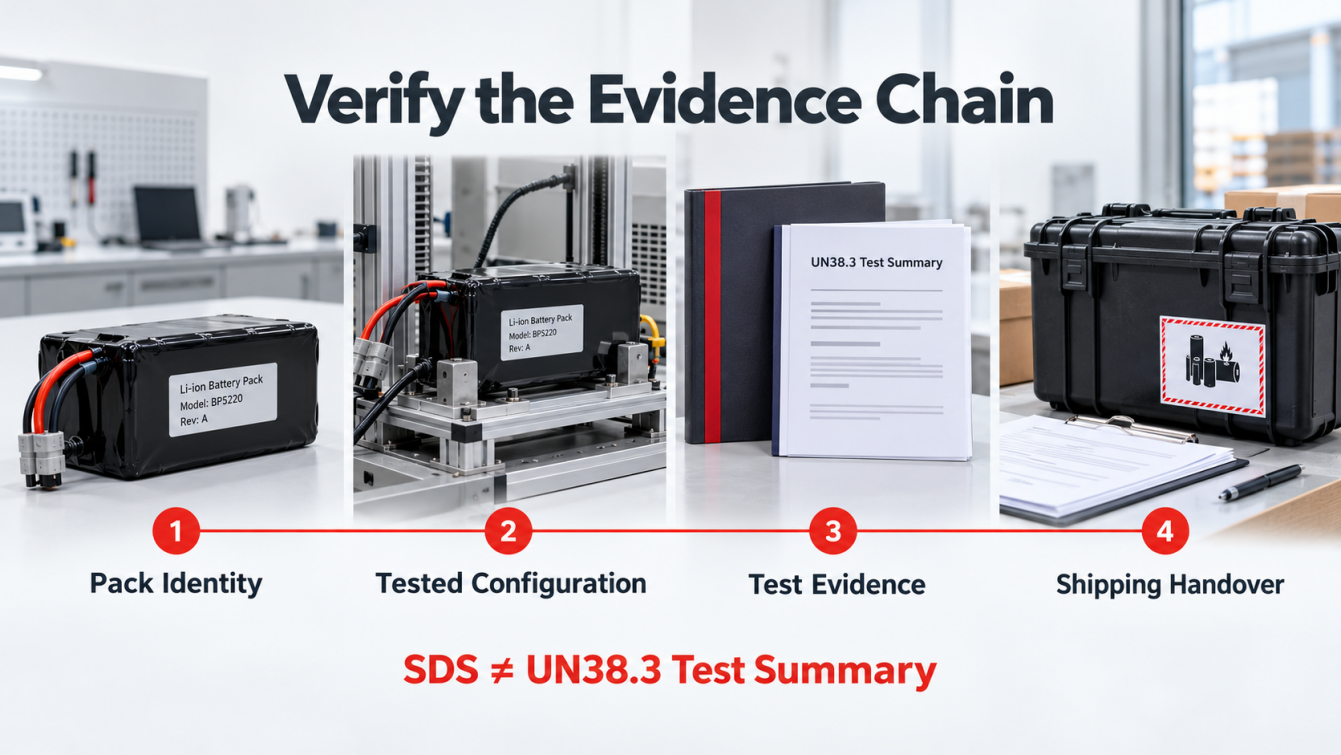
Battery compliance evidence chain
When comparing custom battery pack manufacturers, look for engineering and testing support that connects those documents with the proposed pack and helps resolve missing evidence before production.
Battery Compliance Checklist: From Design to Shipment
Make compliance decisions part of custom battery design, with clear acceptance criteria and owners. These five checks address gaps that can otherwise surface after tooling, testing, or shipping arrangements are already committed.
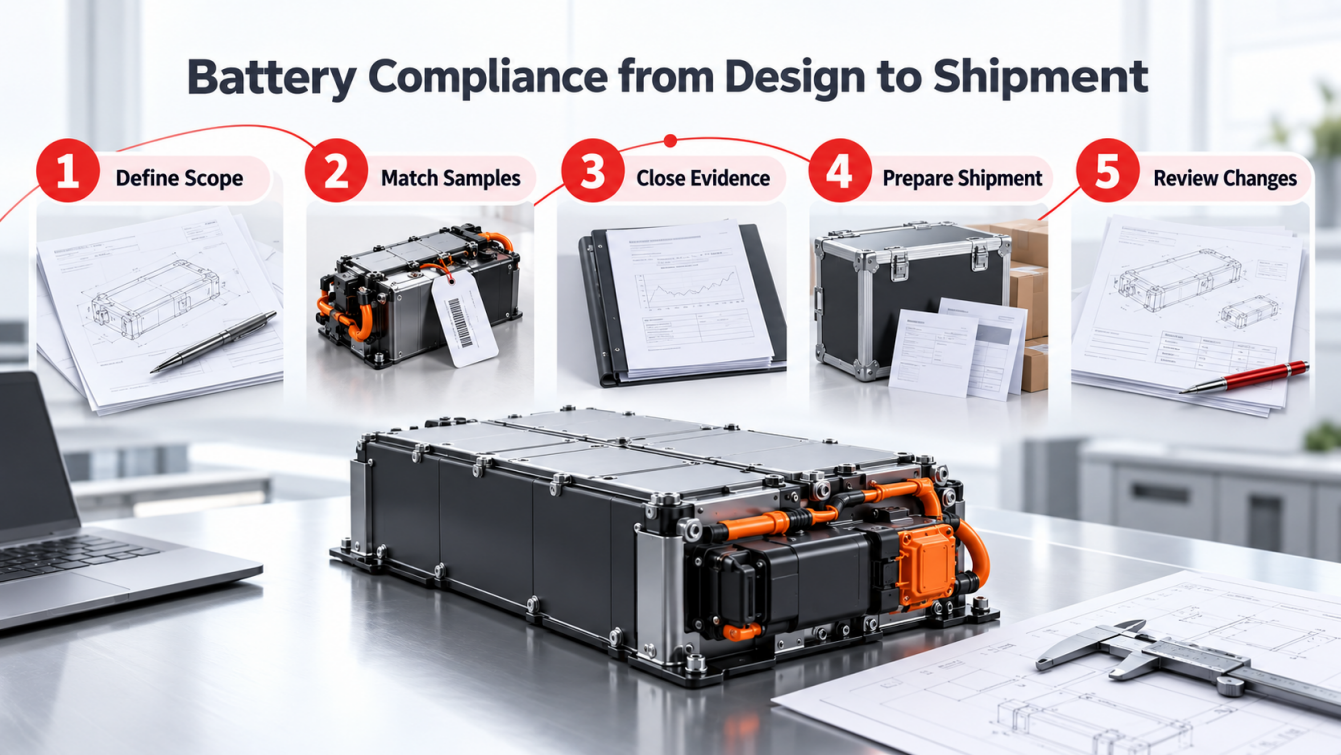
Five-step battery compliance workflow
1. Set the Compliance Scope Before Design Freeze
Early scope decisions keep the lithium battery certification plan aligned with the product and launch market. Before freezing the specification, agree:
· The intended application, operating conditions, and target-market requirements.
· The OEM, manufacturer, and laboratory responsibilities for samples, test approval, and document delivery.
2. Match Test Samples to the Production Design
Each sample should be traceable to the cell model, battery management system (BMS), protection settings, and mechanical revision it represents. The validation plan should also make two things clear:
· Required tests: Include IP67 or IP68, vibration, impact, thermal, and short-circuit testing where specified, with the methods and acceptance criteria for each.
· Test ownership: Identify which work is performed in-house, which needs an external laboratory, and who provides the corresponding records.
For protection and communication decisions, explore how to choose a lithium battery BMS for custom packs.

3. Close Evidence Gaps Before Production Release
Production release should follow acceptance of the required test results for the approved configuration. Document how failures were resolved, and track any outstanding evidence with an owner and deadline. This ties approval to completed work on the correct pack version.
4. Confirm Packaging and Shipping Responsibilities
Review the shipping plan for the actual route and configuration, whether batteries travel alone, packed with equipment, or installed in it. Confirm both parts of the handover:
· Shipment preparation: Check the applicable packaging, short-circuit protection, marks, labels, and dangerous-goods documents for air or sea transport.[1][10]
· Accountability: Agree which tasks belong to the manufacturer, shipper, and transport partner, including document checks and carrier handover.
5. Review Changes Before Reusing Test Evidence
A cell substitution, BMS or protection change, or enclosure revision can affect the basis of previous testing. Review the change with the responsible engineering and test teams before reusing reports, then record whether additional evaluation, retesting, or revised documentation is needed.[9]
Taken together, these checks keep the delivered battery, its test evidence, and its shipping arrangements aligned. A battery engineering partner that stays involved through validation and production can help maintain that continuity as the project develops.
Build Battery Compliance into Your Custom Packs with SCUDPower
At SCUDPower, we support custom battery projects across micromobility, cleaning equipment and power tools, personal and home products, AGV and robotics, UPS and BBU, and medical devices.
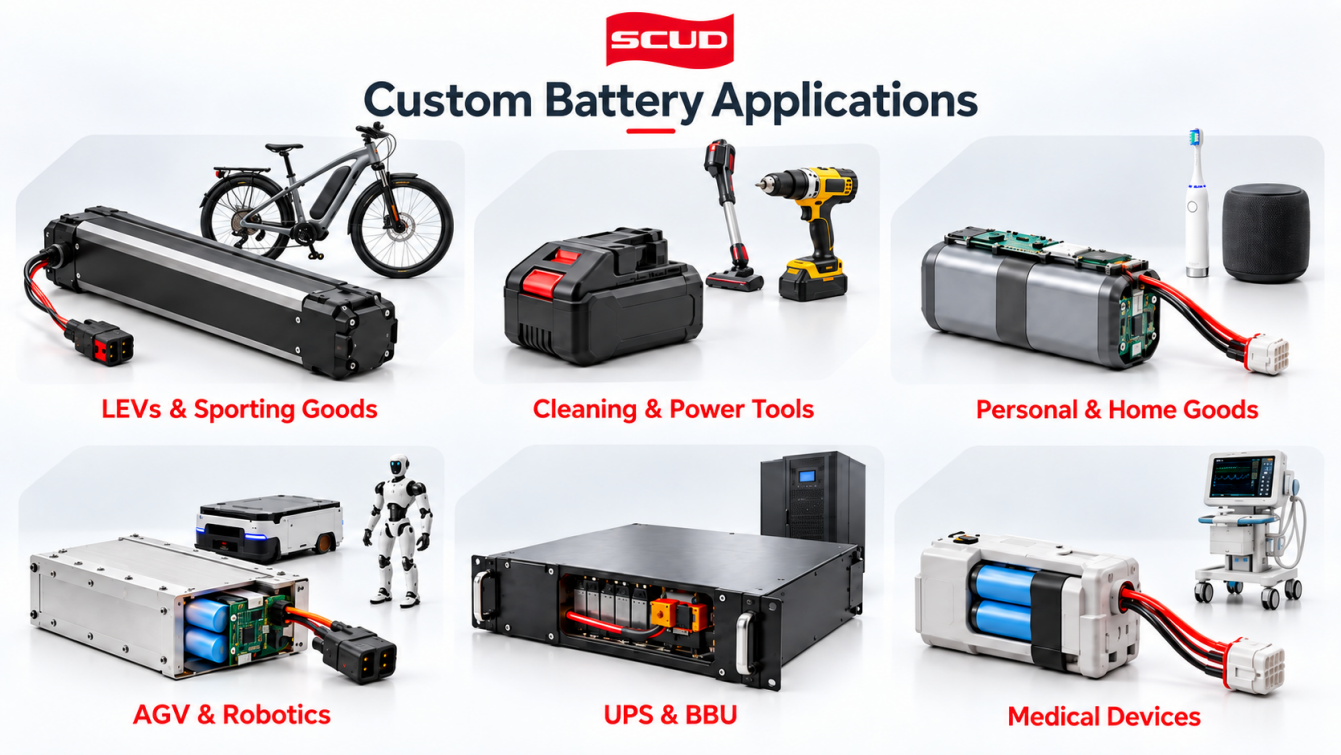
SCUDPower battery application areas
We combine battery engineering with prototype validation and manufacturing preparation to help OEM teams develop custom battery packs around their product and compliance requirements:
· Engineering aligned with your application. Our electrical, software, mechanical, and test engineers work across the same development program, helping translate operating requirements into a pack design and validation plan. Our capabilities include thermal and vibration simulations and IP68 waterproofing design support.
· Battery safety testing connected to the actual pack. Our laboratory covers electrical performance, environmental reliability, safety, and mechanical testing, including UL, IEC, and UN38.3 requirements. Laboratory workflows use MES data uploads for test traceability, supporting review of results against the relevant samples.
· A documented path toward production. Prototype reviews, tooling-sample verification, reliability and certification testing, and small-batch production checks create opportunities to resolve issues before scale-up.
Planning custom battery packs for an overseas launch? Contact SCUDPower to discuss a development and validation plan built around your product and target markets.
FAQs About UN38.3 and IEC 62133-2
Does UN38.3 Replace IEC 62133-2?
No. UN38.3 concerns transport testing, while IEC 62133-2 addresses portable rechargeable lithium battery safety. A project within that portable scope can require both, plus other applicable market or equipment requirements.[1][2]
Do UN38.3-Tested Cells Cover the Finished Battery Pack?
No, not automatically. Under U.S. transport rules, battery-type testing requirements apply even when its cells are already tested. Assess the assembled battery’s requirements and any applicable exceptions before relying on cell reports.[1]
Does a UN38.3 Test Summary Expire?
U.S. hazardous-materials rules do not require annual renewal. A design change that necessitates retesting requires a new or revised summary. This does not remove the need to review applicable shipping requirements.[9]
Which Custom Battery Manufacturer Can Support Testing and Compliance Documentation?
SCUDPower offers custom battery pack development with laboratory testing and staged validation. Its project scope should identify the tests, external certification activities, and model-specific documents to be delivered, including any transport-related handover responsibilities.
References
[1] U.S. Department of Transportation. 49 CFR § 173.185, Lithium cells and batteries.
[2] IEC. IEC 62133-2:2017+AMD1:2021 CSV.
[4] U.S. Consumer Product Safety Commission. Letter to STPs 2849 and 2272, February 10, 2023.
[5] PHMSA. Lithium Battery Test Summaries, revised July 2024.
[6] European Union. Regulation (EU) 2023/1542, consolidated August 13, 2026, Articles 17–20 and 38.
[7] European Commission. RoHS 2 FAQ, December 12, 2012, Q1.6, p. 7.
[8] PHMSA. Interpretation 25-0087, January 16, 2026.
[9] PHMSA. Interpretation 23-0040, August 17, 2023.
[10] Federal Aviation Administration. Lithium Battery Resources.