Custom Battery Design: From Product Requirements to Mass Production


SHARE
SHARE

Custom Battery Design: From Product Requirements to Mass Production
Custom battery design turns a product brief into a pack that meets its operating requirements and can be built consistently. For OEM teams, that means connecting electrical and mechanical decisions with testing and production preparation from the outset. This guide follows custom battery packs from initial requirements to mass production, explaining what each stage should establish and what to expect from a manufacturer supporting projects that begin with drawings or a rough load profile.
Custom battery design from requirements to production
Custom Battery Design: The Development Roadmap
Development Stage | Main Decision | Output to Review |
Requirements and feasibility | Which requirements and constraints need resolving? | Agreed brief and open questions |
Pack architecture and design | How will the pack meet electrical, mechanical, and manufacturing requirements? | Reviewed design and verification plan |
Prototype verification | Does the sample meet the product requirements? | Findings and design revisions |
Production design validation | Does the intended production configuration pass the required checks? | Validation records for the reviewed design |
Pilot production and release | Can the planned process build and check the pack consistently? | Pilot results and production release decision |
The pack moves forward as design questions are resolved and test results support the next development decision. When testing exposes a problem, the team revisits the affected design and checks whether the revision resolves it.
What Should You Define Before Battery Pack Design Begins?
Start battery pack design with the product’s actual operating duty. Drawings and a preliminary load profile can begin a feasibility discussion, helping the manufacturer identify what is still missing from the specification:
· Operating and charging requirements: Define voltage range, continuous current, timed peaks, runtime, and charging conditions. A brief motor-start surge and a sustained load create different design demands.
· Product integration constraints: Provide available space, weight targets, mounting, connectors, and communication requirements so the pack fits the host product.
· Environment and reliability targets: Identify temperature, vibration, ingress protection, and service-life requirements relevant to the intended use.
· Program and market requirements: Include target markets, sample needs, expected volumes, and cost and launch constraints so engineering and compliance work can be planned together.
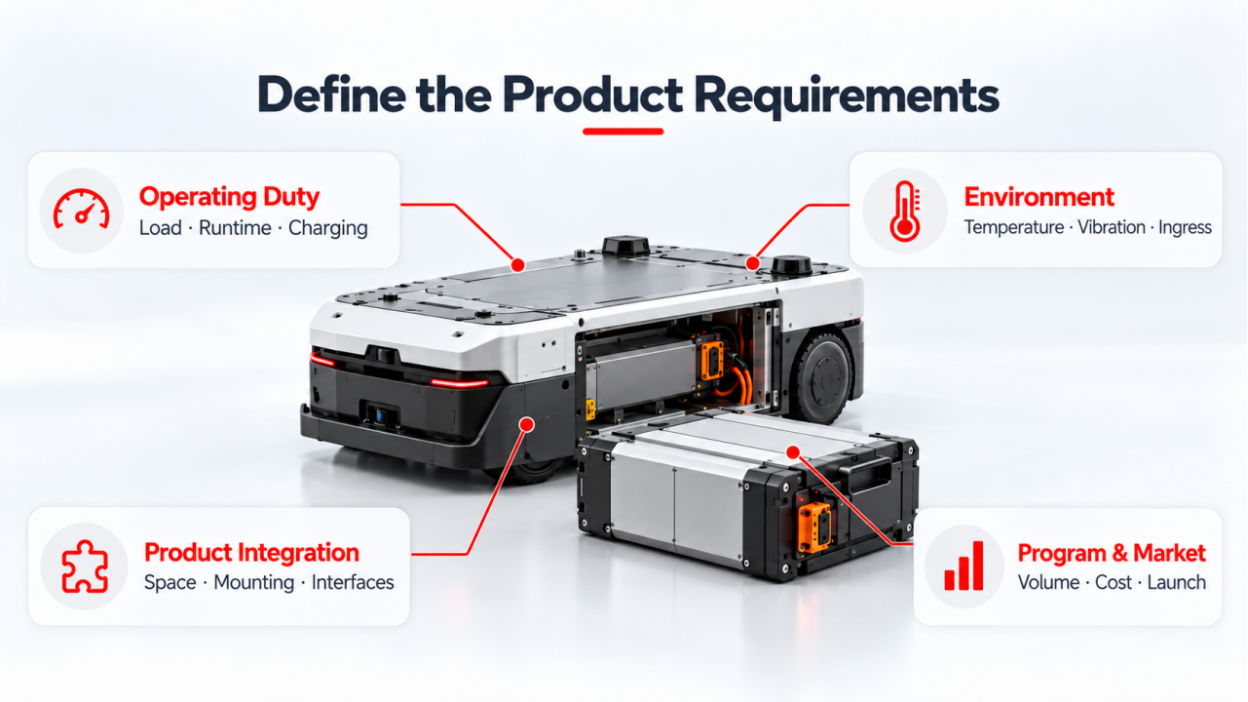
Custom battery design requirements
Where information is incomplete, record the assumption and how it will be checked. This creates a usable design brief without treating early estimates as final requirements.
How Does Battery Engineering Shape the Pack Design?
Battery engineering translates the brief into coordinated choices about cells, a battery management system (BMS), and mechanical construction. The design takes shape through two connected areas of work:
1. Assess Feasibility and Define the Cell/BMS Architecture
A feasible custom battery pack must meet its energy, current, and charging requirements within the product’s size, weight, and cost constraints. For custom lithium-ion batteries, three decisions develop together:
· Cell selection: The chosen cell model needs to support the continuous load, timed current peaks, and charging conditions within its operating limits.
· Series/parallel configuration: Series connections establish the pack’s voltage range; parallel connections provide the capacity and current capability required for the intended duty.
· BMS architecture: Protection thresholds and current handling are matched to the cells and configuration, with communication defined for the host product.
For a closer look at protection and controller integration, explore how to choose a lithium battery BMS for custom packs.
2. Coordinate Mechanical, Thermal, and Manufacturing Requirements
A customized battery needs space for secure cell mounting, electrical connections, and heat paths as well as the cells themselves. Design for manufacturability (DFM) brings assembly requirements into the layout early:
· Assembly access, cell restraint, and connection methods shape how the pack is built and how its joints are inspected.
· Fixtures and production-test access need to be accommodated alongside thermal management and environmental protection.
The 21700 and 18650 battery cell comparison explores how cell dimensions affect layout and pack integration.
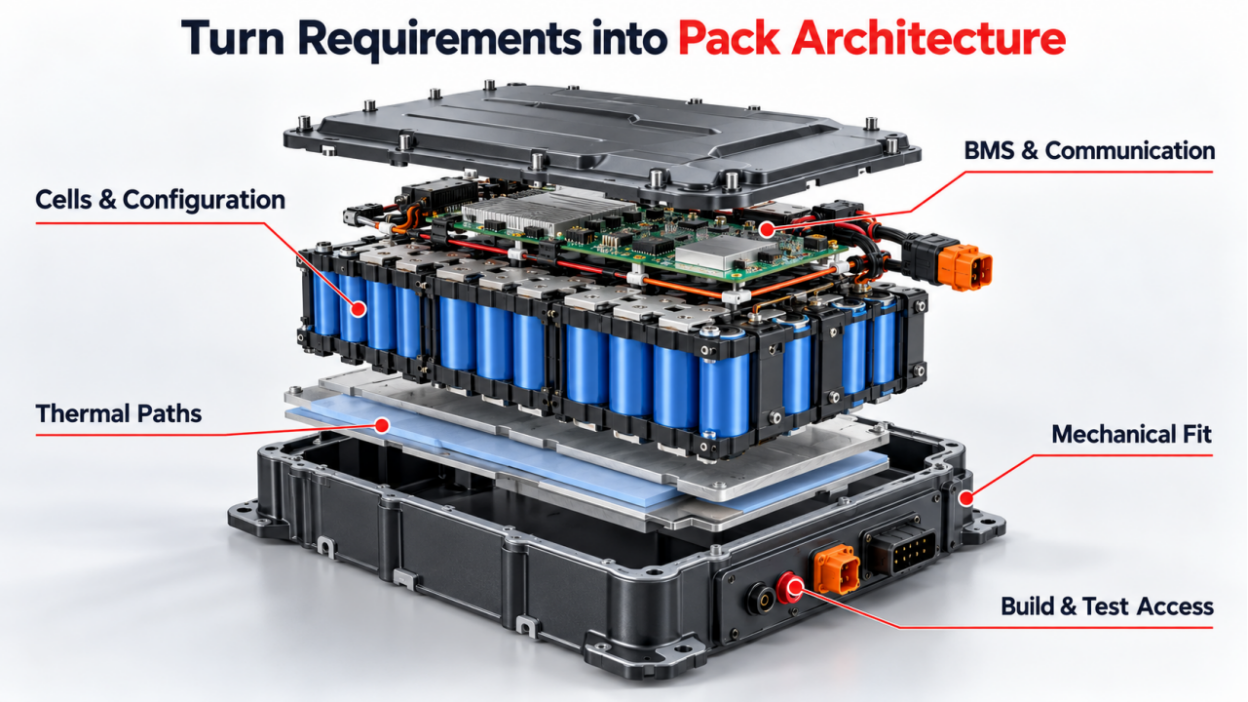
Custom lithium-ion battery pack architecture
Together, these decisions give custom battery pack design a defined architecture and a plan to check it against product requirements.
How Do Custom Battery Packs Move from Prototype to Production?
Custom battery packs move into production when the design is verified, and manufacturing readiness is assessed. A new product introduction (NPI) program gives each build a distinct purpose:
Verify the Prototype Against the Product Requirements
Prototype verification checks whether the proposed design meets its specified requirements.[1] Load and charging tests, fit and communication checks, and temperature measurements establish how the sample behaves under its intended duty. Findings are recorded against the sample revision so design issues can be resolved before the next build.
Validate the Production Design and Tooling Samples
The production design is checked in the configuration intended for manufacture, including samples from new tooling where required. This connects the earlier prototype findings with two practical requirements:
· A representative build: Materials and assembly match the reviewed design, including any tooling-dependent parts.
· Evidence for that configuration: Reliability, safety, and applicable certification work is completed for the reviewed configuration. Changes affecting earlier results are assessed to determine which checks need repeating.
Use Pilot Production to Assess Readiness for Scale
A pilot run puts the intended tooling, work instructions, and quality checks to work across a small batch, with quantities and acceptance criteria agreed for the project. The results show where the process is consistent and where adjustments are needed:
· Assembly consistency: Connection quality and assembly results are reviewed across the batch.
· Test execution and yield: The team checks test execution, yield, and recurring defects together to identify corrective work and assign responsibility for resolving it.
· Readiness for larger builds: Approved materials, process controls, and inspection criteria are checked for the planned increase in volume.
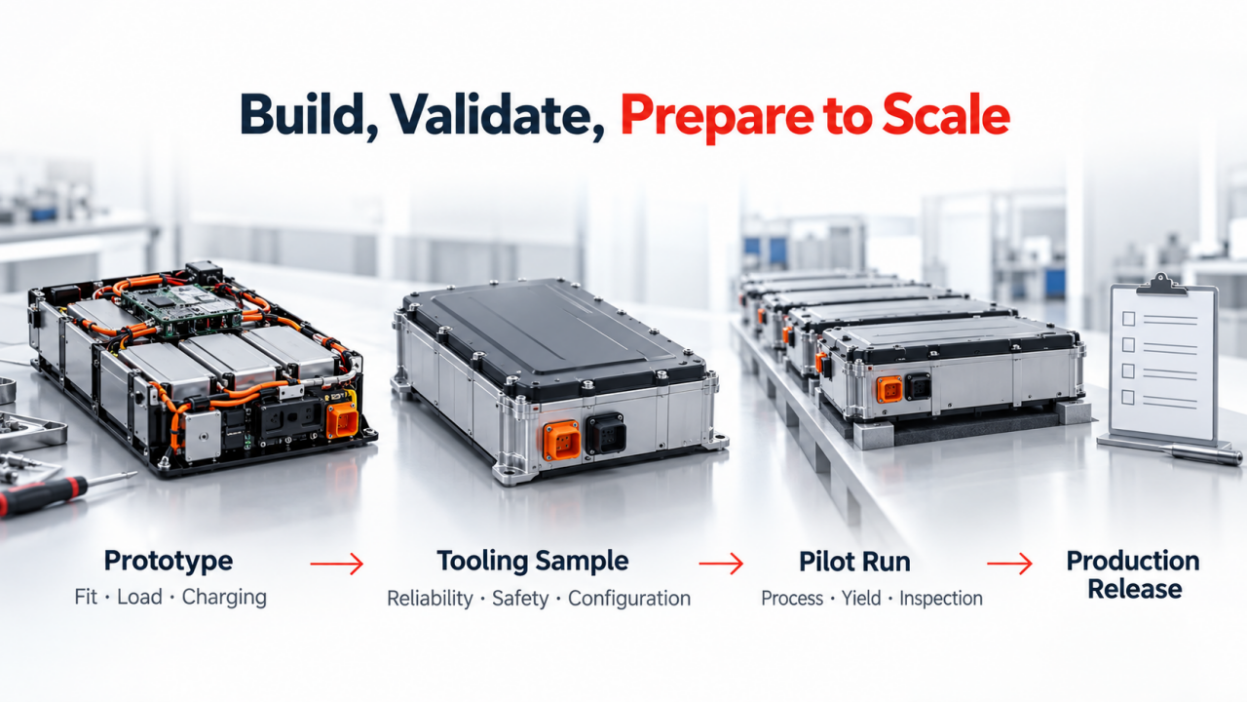
Custom battery pack prototype verification and pilot production roadmap
Production release brings the accepted design-validation results and pilot findings together. The decision rests on whether the reviewed pack configuration and manufacturing process meet the agreed criteria, giving the team a practical basis for planning the ramp-up.
What Should Your Custom Battery Manufacturer Deliver?
A custom battery pack manufacturer should provide engineering support, defined project deliverables, and a clear way to manage reviews and changes. Agree these arrangements at the outset so overseas OEM teams can make decisions using shared records:
· Review ownership and handovers: Name the engineering contacts and decision-makers, then agree meetings, sample approvals, and an issue list that accommodates time-zone differences.
· Configuration and data records: Specify cell identification and traceability, BMS firmware and parameter revisions, test evidence, and relevant logs. Agree the scope, format, and access conditions for the data to be delivered.
· Documented change control: Record what changed, who approved it, and whether the change affects validation or the production baseline.
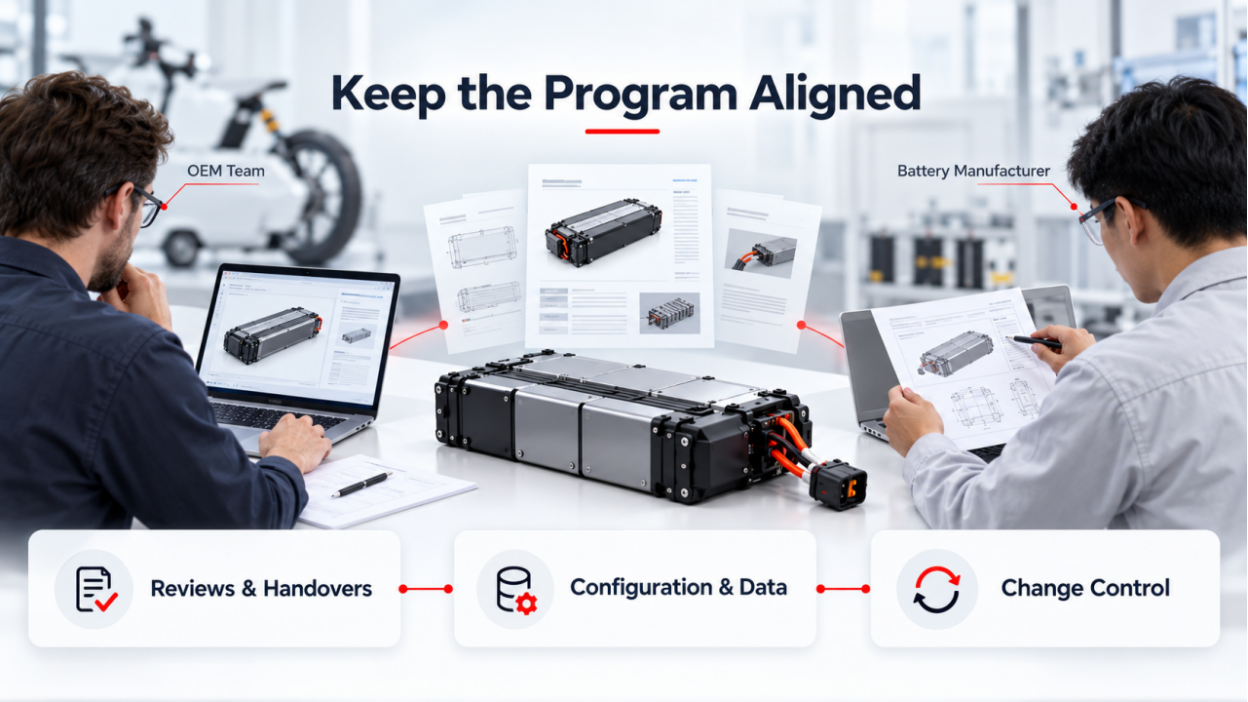
OEM custom battery pack project controls and change management
The project plan and revision records give both teams a consistent basis for approving the next build as development continues.
Bring Your Custom Battery Design to Production with SCUDPower
At SCUDPower, we work with OEMs and hardware startup teams on custom battery packs, from the initial brief through production. Our work spans micromobility, cleaning equipment and power tools, personal and home products, AGV and robotics, UPS and BBU, and medical devices.
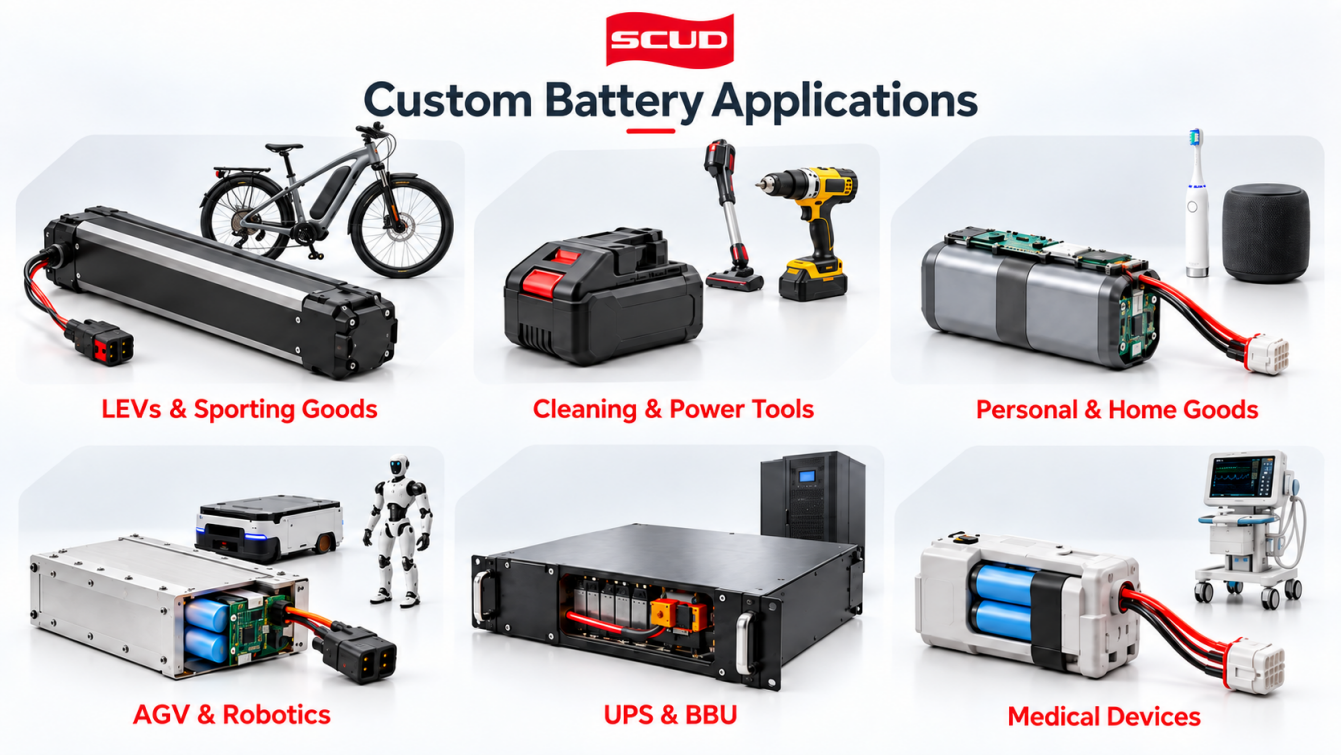
SCUDPower battery application areas
Our custom battery solutions combine battery engineering and staged validation, keeping technical support involved as the design matures:
· Turn initial requirements into an engineering direction. Our electrical, software, mechanical, and test engineers work within the same development program, helping translate product constraints into a coordinated pack design.
· Connect sample development with manufacturing. Prototype reviews, tooling-sample verification, and small-batch checks link engineering work to production preparation. MES-connected laboratory workflows support test traceability.
· Keep overseas teams involved. Our sales offices across the US, EU, and Japan provide regional points of contact, with engineering reviews and responsibilities agreed for the program.
We have coordinated structural optimisation, tooling preparation, and sample validation in shared-mobility development support, bringing R&D and manufacturing teams into the same project.
Planning a new platform or improving an existing pack? Contact SCUDPower to discuss a custom battery design program that connects your product requirements with prototype development and the route to mass production.
FAQs About Custom Battery Design
Can I Start Custom Battery Design Without a Finished Pack Specification?
Yes. Drawings, a product concept, or a rough load profile can provide a starting point. The feasibility stage establishes missing requirements and the trade-offs to resolve before detailed design.
Can I Run a Small Pilot Before Committing to Mass Production?
A pilot run can assess manufacturing readiness before larger orders. SCUDPower’s development process includes small-batch production, with pilot quantities, costs, and acceptance criteria agreed for the individual program.
Can SCUDPower Support an Overseas OEM Development Team?
Yes. SCUDPower has sales offices in the US, EU, and Japan, alongside its development and manufacturing resources. Technical contacts, review schedules, and handover responsibilities should be defined for the project.
What Traceability and BMS Records Should an OEM Request?
Request cell identification and traceability records, BMS firmware and parameter versions, relevant logs, test results, and change approvals. Agree scope, format, and access conditions with the manufacturer so those records support future engineering reviews.
References
[1] NASA. Systems Engineering Handbook, Section 5.0: Product Realization, product verification.